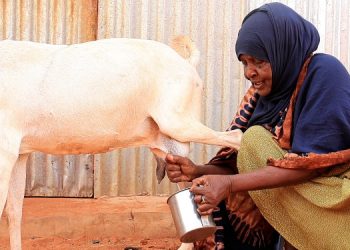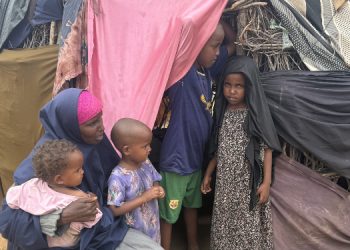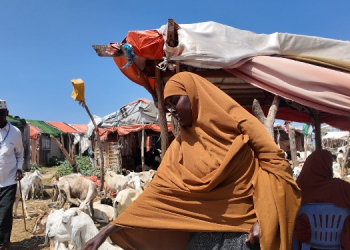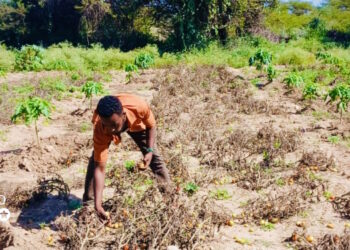


Pastoralist families left behind in Dajimaale village in Somalia’s central Mudug region are facing severe food and water shortages after three consecutive years of failed rains destroyed their livestock and dried up the water wells.
Most residents have migrated away in search of water and pasture, but more than 100 families, largely comprising elderly people, widows, and households without the means to move, are stranded in the village.
Busuri Abdikadir Ahmed has lost all his goats and can’t provide for his family of 10.
“Drought has taken everything from us. We have no water, no proper food, and no healthcare. The few animals that survived have now disappeared. We no longer know when we will eat. Sometimes we manage just one meal a day, but there is no certainty,” he told Radio Ergo.
Busuri, 56, said relatives sent them five kilograms each of flour, rice, and sugar earlier in June after learning of their situation. The food has been stretched by cooking only one meal a day, but the supplies are almost exhausted now.
A barrel of water transported from distant villages costs about $6, as prices have been driven up by poor roads and increased transport. The villagers queue daily at the area’s remaining shallow wells, which together produce only about five barrels of water every 24 hours.
Busuri often joins the queue before sunrise hoping to collect a single jerrycan, although many days he returns home empty-handed. The poor-quality water has also contributed to illness. Three of his children have spent the past week suffering from diarrhoea and fever.
“Diseases are spreading because of the water shortage. People are getting diarrhoea and bacterial infections from the water we are forced to drink. My own children are sick, but we have no medicine and they are already weak because of hunger,” he said.
Several times Busuri considered moving his family to Galkayo, about 110 kilometres away – but transporting a household of 10 would cost at least $100, far beyond anything he can afford. He also fears the journey would be too difficult for his elderly relatives and sick children.
With the village’s only functioning wells continuing to dry up, he believes remaining in Dajimaale is becoming impossible.
Sadiyo Abdi Hussein, a 55-year-old widow caring alone for 10 children, survives largely on food occasionally given by neighbours. Some days the children don’t eat at all. The family is able to collect no more than 10 litres of water a day.
“Our biggest problem is the lack of water. The drought has made life unbearable. Sometimes we find food and sometimes we don’t, but water and healthcare are the greatest challenges. If assistance comes, those are the things people need most,” Sadiyo said.
Repeated drought over the past three years gradually wiped out the family’s small herd of goats that was their only source of livelihood.
Eight months ago, her husband died after an illness as the family could not afford medical treatment.
“There is no hospital here. Even basic medicine isn’t available. If someone falls seriously ill, we can’t afford to hire a vehicle to take them to Galkayo because it costs between $300 and $400. We were pastoralists, but our livestock are gone,” she said.
Her children are visibly weak from lack of food and she fears they may be malnourished. She has considered moving elsewhere but cannot afford transport for her children and their belongings. Most families who were able to leave Dajimaale moved to areas where water is available.