

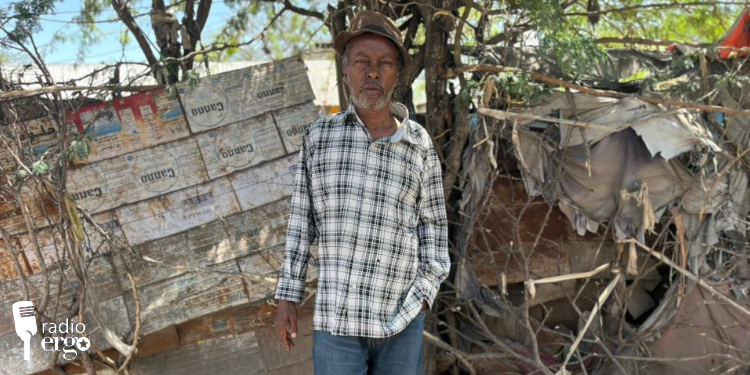
(ERGO) – Ismail Jama Ali has been struggling to support his family of 12 since falling ill and being diagnosed with diabetes in February.
The diagnosis came suddenly when he collapsed from shock following the death of a nephew. He was taken to Gabiley hospital in Somaliland where doctors discovered he had diabetes that he then realised had been affecting him for months.
“At first I thought it was a kidney problem. I was always thirsty and urinating frequently. For six months I didn’t know it was diabetes. I felt tired all the time and could barely walk without resting. After my nephew died, I fainted from the shock and that’s when the hospital found out what was wrong,” Ismail told Radio Ergo.
Before falling ill, Ismail supported his family through a tailoring business in Gabiley. The income covered food, rent, water, and school expenses for his children. But his health deteriorated to the point where he could no longer work. The tailoring shop closed, leaving the family without a source of income.
His wife gave birth in early May, adding to the family’s responsibilities at a time when he was unable to provide.
“Three meals a day became impossible after I got sick. The disease weakened me and hunger made it worse. Sometimes neighbours help us, but we are in a very difficult situation,” he said.
The family’s financial collapse has affected their children’s education. Three of Ismail’s children were forced out of school at the end of March when he failed to pay two months of fees amounting to $45. One child was in grade three, another in grade five, while the eldest was in the second year of secondary school.
Ismail said he also owes around $1,200 that he borrowed to cover household expenses and medical needs.
“People keep asking for their money. I tell them I have nothing. Some became angry with me. The closure of my business and my illness destroyed our finances. The children also lost their education because I could no longer afford the fees,” he said.
The family was evicted from their rented home in Gabiley after falling behind on rent. Relatives have since accommodated them in two rooms in Hargeisa.
Medical workers say stories like Ismail’s are becoming increasingly common. The lives of dozens of families in Gabiley have been ruined by diabetes – a scourge affecting many people who are the pillar of their households.
Dr Bilan Ahmed Ismail, who works in the diabetes unit at Gabiley General Hospital, said changing lifestyles, poor awareness, and late diagnosis were contributing to the growing number of cases.
“Diabetes is having a major impact in Gabiley. We have received 76 people with diabetes during the last five months and the numbers continue to rise. Managing diabetes requires more than medicine. Patients need dietary changes, exercise, regular monitoring, and long-term commitment,” she said.
Dr Bilan said many patients were coming to the hospital after living with the disease for years without knowing it. Others delayed treatment and relied on traditional remedies instead of medical advice. She said diabetes affects people physically, economically, and psychologically, causing stress, anxiety, and depression among patients and their families.
Another patient, Saad Abdi Yusuf, 35, said diabetes had left him blind and unable to continue the construction work that once supported him and his younger siblings. He had experienced symptoms for years but never realised they were linked to diabetes.
“I used to suffer from dizziness, thirst, and frequent urination. I also kept getting infections. My eyesight gradually became weaker until I could barely see anything. When I finally went to hospital, doctors told me the diabetes had been in my body for more than nine years,” he said.
Saad used to make around $7 a day working on building sites in Gabiley, supporting three younger siblings following the deaths of their parents. However, unable to work and pay rent, he has spent the past five months living inside Gabiley hospital, where staff have allowed him to stay while receiving treatment.
“My brothers are now living with our aunt because I cannot support them anymore. Sometimes my condition becomes serious and I am moved to the emergency ward. When I recover a little, they return me to my room. This disease has taken away the future I hoped for,” he said.
Health workers warn that chronic non-communicable illnesses like diabetes are increasingly pushing vulnerable families deeper into poverty. Many patients struggle to afford appropriate diets, transportation, and medication, while others lose the ability to work altogether.