

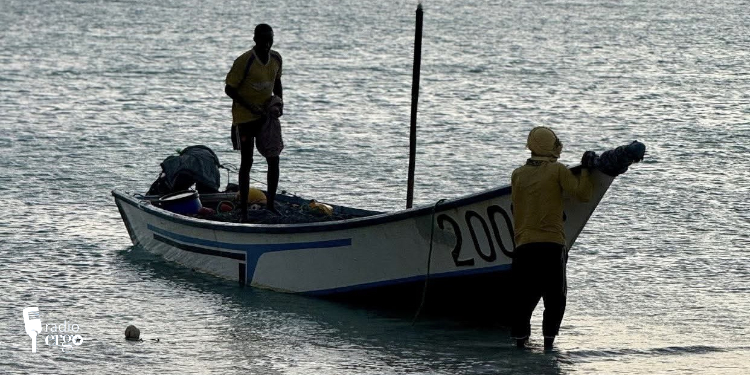
(ERGO) – Mohamed Muse Ali has a heavy responsibility as an income earner for his family of 14 – and the destruction of his fishing gear by a foreign trawler in February has set him back tremendously.
The 10-year fishing veteran is among more than 1,000 fishermen in coastal communities along Puntland’s’ Bari coastline, including Muranyo, Bareda, Alula, Bandar Bayla, Dhadar, and Aris, whose livelihoods have been devastated by violent attacks.
Mohamed told Radio Ergo that his family survives on irregular income from his odd jobs unloading food shipments arriving in Bareda.
“I can’t provide three meals a day for my family. Sometimes I earn a little money unloading food trucks and we cook one meal. Other times we have nothing. You can imagine the situation of someone who has lost his livelihood and has nowhere to earn an income. Life has become very difficult,” he said.
Mohamed was earning $15 to $20 a day selling fish, and making up to $400 a week from seafood including lobster and other marine resources he sold to traders transporting goods to Bosaso.
He lost four fishing nets he had bought on credit at the end of 2025 using a loan of $2,100. He has only repaid $900 so far.
A barrel of water transported from Tageer, six kilometres from his home in Bareda, costs $6. The family relies on borrowing water from neighbours or seeking help from others.
Six of his children dropped out of school in April as he couldn’t pay accumulated fees of $300. He also owes about $5,000 in various debts that creditors keep demanding settlement.
“People ask me for money all the time. I keep telling them to wait, but the pressure is growing. I fear being jailed because I have no way to repay what I owe,” he said.
Another fisherman, Bandar Mohamed Mahmoud, a father of nine, also lost most of his fishing equipment to a foreign trawler attack. His family survives on loans and occasional stone-breaking jobs he gets for $2.50 a day.
Fishing previously generated $25 to $30 a day, enough to meet all the family’s needs.
“Whatever God provides is what we eat. Some days we find work and other days we don’t. Sometimes several days pass without earning anything. We depended entirely on fishing and selling marine resources, but that source of income is gone,” he said.
His wife walks about a kilometre to collect a single jerrycan of free water each day because they cannot afford water sold by donkey carts. Their makeshift shelter is close to collapse, but Bandar lacks the money for repairs. Recent rains in Bari have left the family exposed to rain and cold weather.
Bandar said fishermen tried to protect their equipment when the foreign vessels approached but were powerless.
“We tried to defend our equipment, but they used force against us. Some of the vessels were armed and fired at anyone who came close. We had to save our lives. I lost my nets and other fishing gear. Fishing was our only source of income and now we are living in hardship,” he said.
The collapse of fishing incomes has also affected businesses that supplied equipment on credit. According to fishermen, several companies that financed fishing gear have suspended operations or reduced their activities after failing to recover loans from fishermen whose equipment was destroyed.
The deputy chairman of the Himilo fishermen’s cooperative, Yusuf Samatar Bulhan, said more than 1,000 fishermen had lost their livelihoods due to illegal fishing activities. He estimated that around 500 small fishing boats were now idle because their owners had no functioning equipment left.
“Illegal trawlers are causing serious damage. Many come from Yemen, Iran, Bangladesh, China, and other countries. There is no effective enforcement and we do not have the capacity to stop them ourselves. Hundreds of boats are no longer operating and the affected families are facing very difficult conditions,” he said.
Yusuf called on the Puntland authorities to take action, saying many fishermen were afraid to return to sea because of reports that vessels had fired at local fishermen attempting to protect their equipment.
Illegal fishing by foreign vessels has long posed a threat to the livelihoods of coastal communities in Somalia, where thousands of families depend on marine resources as their primary source of income.