

(ERGO) – More than 400 households who had already been displaced by conflict are facing severe hardship after being displaced again by Juba River floods in May.
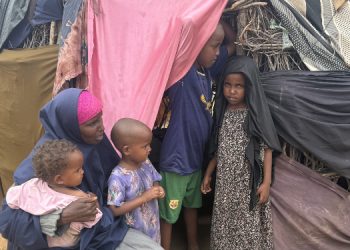
Asho Ali Adan and her family of 12 have been living beside a road near Baar-Sanguuni in Lower Juba region after floods destroyed the settlement where they had sought refuge. They ask passing travellers for food or small amounts of money.
“We survive by asking for help. One person may give a dollar, another half a dollar. Some days I only get 50 cents. If not, the children go hungry. Fifty cents only buys half a kilo of pasta, but that is what we live on,” she told Radio Ergo.
They received cooked or uncooked food or some cash on only two days last week. Mostly they go without meals.
Government soldiers travelling between Kismayo and Mogadishu occasionally share cooked food with displaced families.
“The soldiers sometimes bring us food from what they cook. We have nothing else. There is no work and floodwater has blocked every route,” Asho said.
She used to support her family through food-for-work scheme on a farm in Baar-Sanguuni, where she cultivated and guarded crops in exchange for daily food and vegetables. This kept them going through February, March, and April until the flooding destroyed both the farm and the camp where they lived.
Her shelter built from plastic sheeting and timber provided by a local aid organisation was washed away.
“We have no shelter now and rain falls day and night. Women and children are sitting in the open. We have no plastic sheets and nothing to protect us from the cold. Hunger makes everything worse,” she said.
The family’s difficulties are compounded by her husband’s disability, having been blind for 10 years and unable to support the household.
This is the second displacement the family has endured this year. They fled Jamame in Lower Juba after fighting between government forces and Al-Shabaab destroyed crops of maize, beans, and sesame growing on their 12-hectare farm and forced them to abandon their two-room house.
Another displaced resident, Abukar Nur Sabriye, aid his family of 13 lost everything when floods on 28 May reached the camp where they had settled after fleeing conflict earlier in the year.
“We never expected the water to reach us. During the night we saw floodwater surrounding us from every direction. It carried away our belongings and household items. Everything people had helped us with was lost. We managed to save the children and ourselves, but nothing else remained,” he said.
Abukar’s family now eats only once every two days. Farmers and pastoralists in the area occasionally provide assistance, although they too are struggling with flood-related losses.
His family is living on open ground without shelter, mosquito nets, or protection from rain and cold weather.
“People are sleeping in the open. They have nowhere to shelter from the rain. Mosquitoes are everywhere and there are no mosquito nets. When it rains at night, people run to the walls of village buildings and sit beneath the roofs for protection,” he said.
Abukar used to earn a living doing farm labour. But the flooding halted agricultural activities and cut off the only source of support for his family.
“There is nowhere to work. There are no jobs. Sometimes soldiers bring us food so we can feed the children, but it is only enough for one meal. Local people would like to help us, but they have very little themselves,” he said.
Abukar had fled Bulo-Aji village near Jamame after conflict forced him to abandon his 12-hectare farm and two irrigation pumps.
Baar-Sanguuni chief, Maslah Salim Ali, said the floods had affected the wider community, particularly farming households whose crops were destroyed. He said displaced families were the most vulnerable because they had not recovered from earlier displacement and loss.
“We moved the displaced families to higher ground near the village school. Their biggest challenge is the lack of shelter. They have no mosquito nets and nowhere to protect themselves from the cold and rain. Local residents do not have the resources to provide the assistance needed,” the chief said.