

(ERGO) – Thousands of Somali refugees living in northeastern Kenya’s Dadaab refugee camp complex are struggling to survive after being declared ineligible to receive aid or support due to citizenship designation by the Kenyan government.
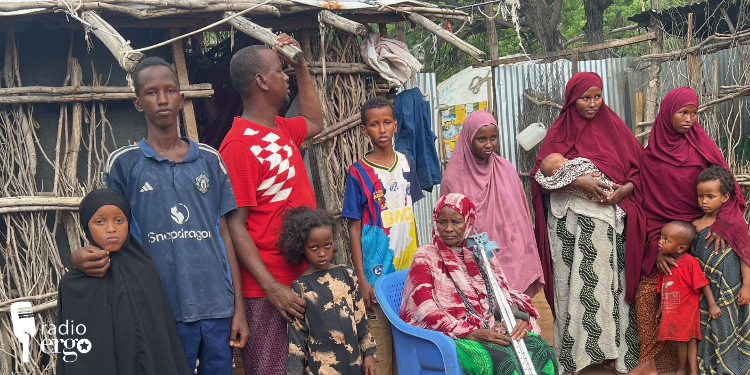
Abdullahi Yasin Warsame, 42, told Radio Ergo that his household of 13 people relied entirely on food distributions and a small cash stipend that suddenly stopped in February.
He and his family were removed from the eligibility list after being classified by the authorities as having Kenyan citizenship.
Abdullahi denies this, saying neither he, his wife, nor his mother are Kenyan citizens, and that his children are all still minors. He said he has not received a clear explanation, despite submitting many complaints to authorities and aid agency offices.
“The situation has changed a lot. When you lose what you had, you realise what it meant to you. We had no other source of income. We depended on the aid card. When it was taken away and we didn’t know why, it caused us a lot of distress,” he said.
His family includes 10 children under the age of 18, and his elderly disabled mother, who has diabetes and high blood pressure. They used to receive 110 kilograms of rice, 40 kilograms of beans, 15 litres of cooking oil, as well as $43 in cash every two months that kept them going.
He said his family had been assessed last year and classified as being vulnerable and in need of continued assistance. Now, he says, the family survives largely on help from neighbours, who themselves have limited means.
Abdullahi works as a night guard, earning about $60 a month. He says the income is too little to cover food, basic needs, and the fees for five of his children who were attending Koranic school costing $35 a month.
He has repeatedly visited aid agency offices seeking answers – but often can’t even gain access to the guarded compounds.
“We have gone back again and again to the offices, but even getting through the doors has become difficult. We complain about lack of food, but we are told the [aid distribution] card has been removed from the system, and we do not know the reason,” he told Radio Ergo.
Abdullahi fled conflict in 1994 in rural Lower Juba region in southern Somalia, where his family had depended on livestock that they have lost.
Kenya’s Department of Refugee Services (DRS) removed about 39,000 people from entitlement to assistance in February, following a verification exercise. Full details of those removed and the reasons were not available for this report.
Camp leaders say some of those removed were reclassified by DRS as Kenyan citizens. Many of those affected had lived in the camps for more than 30 years.
Abshiro Adan Ibrahim, 50, applied for citizenship and became a Kenyan citizen in 2025 after living in the Dadaab refugee camps for 32 years. She thought this would open better opportunities for her.
She continued receiving 100 kilograms of food, 16 litres of cooking oil, and $30 in bi-monthly cash support after her citizenship was granted. But in February, her family of eight was on the DRS list of those cut off from assistance.
“Our overall situation is very bad. You can imagine a family of eight losing their food support. Neighbours who receive food bring us some, and others bring oil. Sometimes women in the neighbourhood collect about 15 kilos of rice and oil for us,” she said.
Abshiro had hoped that acquiring citizenship would help her find work to support her family, as the aid they received was not enough. In July 2025, she travelled to Nairobi in search of employment but returned after a month without success.
She now regrets the decision, saying it has left her family without the support they depended on.
“If I had known that taking [Kenyan] citizenship would lead to this, I would not have done it. I took that step for my five children who depend on me. They have no father and no support. We cannot manage without refugee assistance,” she told Radio Ergo.
Abshiro fled insecurity in 1992 in Sanguuni near Kismayo, where her family had relied on farming four hectares of land.
Camp leaders say the impact of refugees being denied aid is severe. The chairman of Dadaab’s Hagadera camp, Khalif Dhuubow Jelle, said camp leaders and refugee committees had repeatedly raised their concerns with relevant authorities but to no effect.
“These people are very vulnerable. Life in the camps depends on food and security. If food is removed, there is a serious problem. People are confused and suffering. There is hunger, and if assessments are carried out, it will be clear that many are facing it,” Khalif stated.
Refugees in Dadaab currently receive limited water, healthcare, and education services, but continuing food and cash assistance remain central to their survival.
Over the past three years, there has been an incremental reduction in services, food rations and cash support affecting the refugee population in Dadaab. This is attributed to changes in policy around the existence of the camps, as well as to funding cuts.