

(ERGO) – More than 100 dispossessed pastoralist families are facing worsening hunger, water shortage, and shelter hardship after fleeing to Ramaas displacement camp in Harfo district in central Somalia’s Mudug region.
These newly displaced families arrived in several waves beginning in February, after drought wiped out their livestock in rural parts of Nugal and Mudug regions.
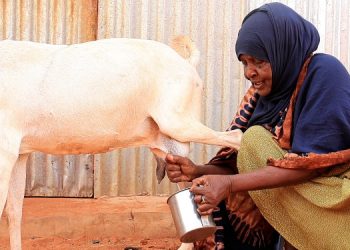
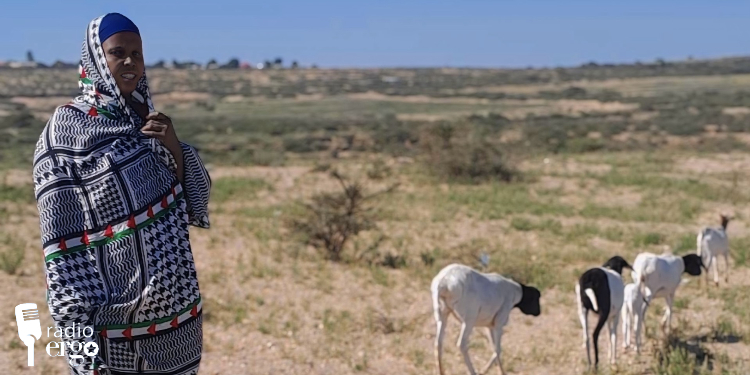
Waris Mohamed Osman, a mother of five, arrived in Ramaas camp after losing the last of her 120 goats to drought in the rural area of Maygaagle near Burtinle.
Her livestock had sustained her family for years through milk sales, meat, and occasional livestock trading. But after months without sufficient rain, the animals gradually died from hunger and thirst.
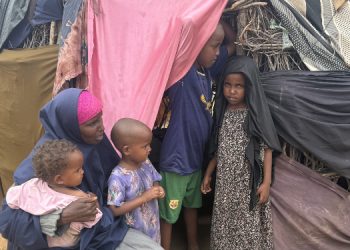
Now living in a shack made of sacks and torn cloth, Waris says her family lives on one small meal a day obtained on credit.
“Sometimes we sleep hungry and sometimes we cook a little food. There are days and nights when we don’t get to light a fire for cooking,” she said.
Waris is the sole provider for her children since separating from her husband. Before the drought, the family survived comfortably off the income from their livestock.
Ramaas camp has no water point, forcing women to walk long distances in search of water. Waris said the nearest well is around three kilometres away and a 20-litre jerrycan costs about 25 US cents that she can’t afford regularly. She relies on relatives or pleads with well owners for a single jerrycan of water for essential use.
The drought left her with debts of around $770 owed to traders back home in Maygaagle and shops in Harfo, where she has taken food on credit since arriving.
Adding to her hardship is the condition of one of her daughters, who requires constant supervision.
“My daughter is sick and has epilepsy. I cannot leave her alone to search for work. When she has seizures, she falls and hurts herself. I stay beside her all the time but I can’t afford medicine anymore,” said Waris, who has never lived in a displacement camp before.
Another displaced mother, Hawo Ali Hassan, arrived in Ramaas camp with her family of 11 after drought killed the 45 goats they depended on in Habar-jiil village near Burtinle. They have five feeble animals left that don’t provide any milk and have no market value.
Hawo’s children often sleep hungry because the family depends entirely on random assistance from relatives.
“If we get one meal out of three in a day, we consider ourselves lucky. Sometimes we get food and sometimes we do not. Back in our village we knew people who could lend us food or we could sell livestock. Here we know nobody,” she said.
The nearest water source is about an hour’s walk away and women carry water containers on their backs because they have no transport. They fear the insecurity of walking in the bush – some girls were recently chased by a group of men. At times the well breaks down, leaving families without water.
Ramaas camp has no amenities at all.
“The place has no school, no Koranic school, and no water services. We have become poor people living in shelters that can’t protect us from heat or cold,” said Hawo, who has five children of school age.
Her husband, who worked in construction jobs, has repeatedly searched for casual labour in Harfo town without success.
“He tried breaking stones to sell but nobody bought them because people prefer those they already know. Now he stays idle most days,” Hawo said.
The family faces pressure to repay $500 in debts accumulated in their home village. Hawo had expected to repay the loans after her livestock recovered, but the animals died before that happened.
Ramaas camp chairperson, Fadumo Jama Issa, said the new arrivals joined about 350 families already living in the settlement. The camp’s limited resources were already overstretched before the recent influx.
“These people are at risk of dying from hunger and thirst. They do not even have proper shelter from the heat and cold. They are living a hardship they never knew before,” Fadumo said.
She appealed for urgent support including food, water, shelter, healthcare, and livelihood assistance to help the displaced rebuild their lives: “Eventually they need livestock or work opportunities because that is the life they know. But before all that, they first need immediate help to survive.”