

(ERGO) – Having grown up as a refugee in the Dadaab camps in Kenya, Adan Jumale Hassan, 28, runs a small electronics, money transfer, and grocery shop that is supporting his entire family – even at a time of aid cuts and economic downturn.
Adan opened his shop last November in an area outside Dagahaley camp with few other businesses and now attracts a steady base of customers, making 800 to 1,000 Kenya shillings a day ($6-8) that is enough for the family of seven.
“Since I started this business, I have managed all my family’s needs. We now afford food, healthcare, education, and even savings. I feel proud to have gained financial independence,” Adan told Radio Ergo.
They used to live off food aid distributed in the camp and Adan’s 15,000 Kenyan shillings monthly salary working in another man’s shop. He saved 6-7,000 shillings every month from his wages for four years – accumulating nearly 200,000 shillings to start up on his own last year.
The new income allowed him to build a corrugated iron-sheet room for 70,000 Kenyan shillings in February to replace the hut they were living in.
“It removed a major burden from us. Before, I constantly worried about where my family would stay during rain and strong winds,” he said.
Adan hopes to expand the business and become a wholesaler supplying goods to smaller traders in the camp: “I buy goods from larger traders, but one day I hope to become the supplier others depend on. I also want to improve my family’s future even more.”
Adan’ was born in Kismayo to a rural pastoralist family, who fled conflict in Lower Juba region in 1998 and came to Kenya as refugees. His parents never managed to establish another livelihood.
His business has enabled him to enroll his daughter in Koranic and formal education for the first time, for 1,500 Kenya shillings a month. He hopes to enroll two more children in the coming months. He says he delayed sending the children to school whilst he was focused on saving to establish his shop.
He believes his education in Dagahaley camp, where he got his Kenya certificate of secondary education in 2018, helped him manage the business successfully.
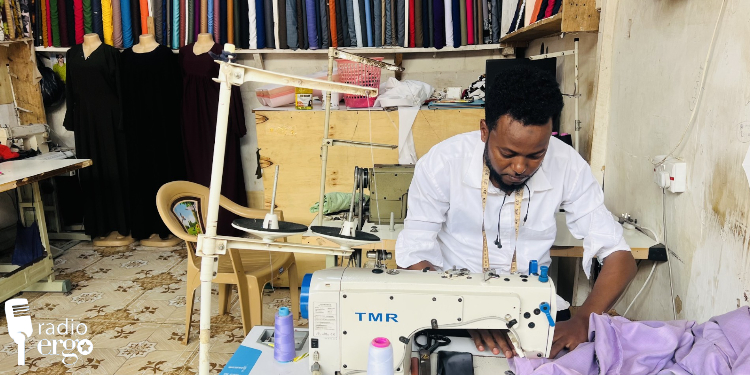
Other refugees are turning to self-employment after humanitarian jobs and aid opportunities declined. Abdulkadir Ahmed Omar, 38, opened a tailoring and clothing shop in Hagadera camp after years of working for someone else.
Using savings accumulated from a monthly salary of 15,000 Kenyan shillings, he raised around 600,000 shillings over five years (approx. $4,600) and established his own tailoring business. It now earns him about 1,000 Kenya shillings a day and fully supports his household of 10 people.
“This work changed many things in our lives. I now earn enough to provide for my family. My children, parents, and siblings all depend on me and this business is our only source of income,” Abdulkadir said.
His family arrived in Dadaab in 2004 after drought and conflict forced them off their farm in Jamame district in Lower Juba region, where he was born.
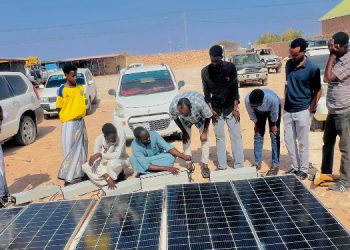
In Dadaab, the family had been struggling to cook one or two meals a day. Initially, Abdulkadir started the tailoring shop in a room in his family home instead of renting commercial premises, and avoided electricity costs by purchasing solar panels to power his equipment.
The business has created jobs for four other young men, each earning 300 to 500 shillings daily. He intentionally hired youth facing unemployment and difficult living conditions.
He also trains young people in tailoring skills free of charge, having trained eight young men and women in the past three months, who are now earning income independently.
“I learned tailoring for free myself, so I wanted to pass that opportunity to others. I used to work for someone else, but I dreamed of owning my own business and it finally succeeded,” he said.
Abdulkadir dropped out of school in eighth grade. However, he says learning a practical vocational skill enabled him to prosper. He is now saving 4-5,000 Kenya shillings monthly to further expand the business.
The chairman of youth organisations in Hagadera camp, Mohamed Abdullahi Jumale, said more young refugees had turned to entrepreneurship in the past six months as humanitarian aid and casual jobs linked to aid agencies declined.
He said more than 500 new small businesses had emerged in the Dadaab camps during that period, employing nearly 600 people.
“The biggest impact on youth came when the jobs provided by aid agencies disappeared. Young people realised they had to create their own opportunities to survive and support their families,” Mohamed said.
He added that youth organisations were encouraging self-reliance through awareness campaigns and business mentoring.