

(ERGO) – On the outskirts of Afgoye, in southern Somalia’s Lower Shabelle region, 63 displaced families have finally secured land of their own after years of repeated evictions, thanks to a donation inspired by a 2025 report aired by Radio Ergo.
Habibo Abdirahman Ali, 45, whose family has been uprooted from 10 different displacement camps over the past four years, says the support came after Radio Ergo highlighted the families’ struggle to obtain permanent land. A local businessman listening to the broadcast was prompted to contribute $29,169 to purchase plots for them on the outskirts of the town.
The step marked the end of a long and exhausting chapter of Habibo’s life, defined by instability and repetitive evictions from temporary housing.
She had been paying $4.5 every month into a rotating savings scheme [known as ayuuto] formed by 103 families in Hilac Wanaag camp in Garasbaley district of Mogadishu.
The collective initiative was designed to help members pool their small contributions to purchase plots of land. But the payments were a heavy burden for families already struggling to cover even basic needs.
“When I thought about getting that land one day, I would sleep dreaming about it and wake up thinking about it,” she said.
“Now God has made it possible. My children and I cannot contain our joy. Some of them thought it was a lie until we were taken to see the land ourselves in Afgoye. Our happiness cannot be described!”
Habibo received a 12-by-12 metre plot in early December 2025.
No longer having to contribute to the saving scheme means she can redirect money towards her children’s education. She has enrolled two of her daughters in a private afternoon course focused on emergency health care, while they attend free conventional classes in the mornings.
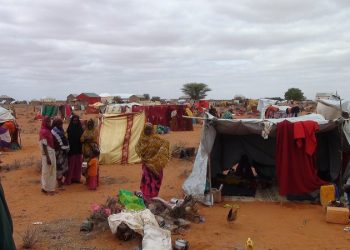
The family currently lives in Hilaac Wanag camp in Garasbaley, where the private landowners have repeatedly ordered them to vacate. Habibo plans to build a simple hut on her new plot to escape the cycle of forced evictions she has faced.
She believes the opportunity would not have come without the media coverage that brought their plight to wider attention.
“Radio Ergo played a huge role. They took our story outside and made it known. Without them, who would we have told? Now I have land. My worries are gone. I will build my hut and we will no longer live in fear,” she told Radio Ergo’s local correspondent following up on the story.
Habibo earns a meagre living from a small kiosk selling powdered milk, sweets, and other small goods, making no more than two dollars a day. She has been in small business for nearly 10 years, but repeated displacement has undermined expanding her business and seeking sustainability
Originally displaced from Qoryoley district in Lower Shabelle region in 2021 due to insecurity, she said instability has been the greatest obstacle to progress.
Mohamed Aweys Mohamed, the chairman of Hilac Wanag camp and one of the displaced himself, introduced the idea of saving for their own land after multiple forced evictions convinced him that renting or settling on privately owned land was unsustainable.
In August 2025, 103 families launched the savings group, called “Tiriye.” Through pooled contributions, they managed to buy 40 plots before the businessman’s donation enabled the remaining families to receive land free of charge.
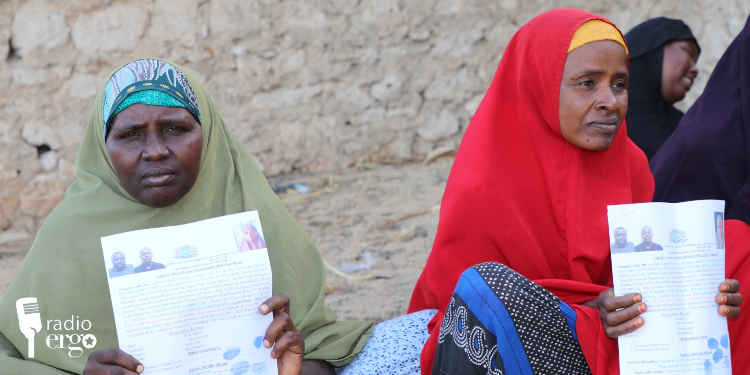
“Our goal was to teach people that they can work together to solve their problems,” Mohamed Aweys said. “We have been evicted many times without notice. We needed a permanent solution.”
Ali Hasan Ali, 47, was among those who helped organise the savings effort. He is a manual labourer who digs latrines and pits when he can find work. Contributing $4.5 a month was often difficult.
“Some families cannot even light a cooking fire. For labourers like us, work is not regular. Sometimes we cannot manage even that small amount,” he said.
He estimated it would have taken more than five years for the group to secure plots for all members through savings alone. When they were informed that additional land had been purchased for them, he said he wept with relief.
“We cried out of happiness. We did not expect to reach this success so soon!” he said.
The newly acquired plots are located in Boodboodka area of Afgoye district, where the families hope to rebuild stable lives after years of uncertainty in camps such as Danyar, Doon Burale, Alafuto, and Haduman, from which many were evicted at short notice.
While challenges remain – including the need for support to construct permanent shelters – community leaders say the psychological impact of owning land is already profound.
“We are people with a vision,” Mohamed Aweys said. “If we are supported, we can build our homes. We will not waste what we are given.”
For the 63 families who received land through the donation, the plots represent more than property. After years of landlessness, forced movement, and insecurity, ownership offers a sense of dignity and stability that long seemed out of reach.