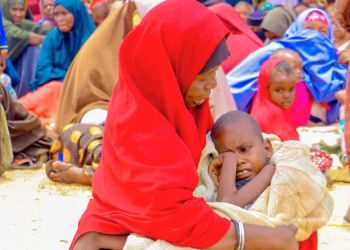


(ERGO) – A collective of displaced families living in Hilaac-wanaag camp in Mogadishu have taken a bold step towards stability by pooling their limited resources to buy land hoping to build a future free from the constant threat of eviction.
The group of 103 families in the camp, in Garasbaley district of the capital, formed a rotating savings and credit association [ayuto] in 2022. They bought a piece of land where all of them will eventually be able to have their own small plot to develop and live.
Each member pays $4.50 a month in to the savings scheme. So far, 35 of the families have been given their 12 x 12 metres square plot on the land in Bod-bodka in Afgoye, about 30 kilometres from the city.
One of them, Mohamed Hasan Ilmi, a 56-year-old father of nine, said the moment he received his land ownership document brought him peace of mind.
“When I got my own land through this savings scheme with my brothers and sisters, my heart calmed down, and I was happy,” he said. “The land is there. It’s empty at the moment, but if I am displaced from here, I will pack up my hut and say, ‘friends, I am leaving.’ Whoever has land there should follow me. I will not have to wander elsewhere. I will build my hut on my land,” he told Radio Ergo.
Each plot of land has been valued at $450. The Hilaac-wanaag camp group paid $5,000 upfront to the landowner, a local businessman, and have so far paid a total of $15,750 for the 35 plots already given out to the group members.
Eventually the remaining 68 members of the group will get their plots as well, as all the members continue with their monthly payments to the savings scheme.
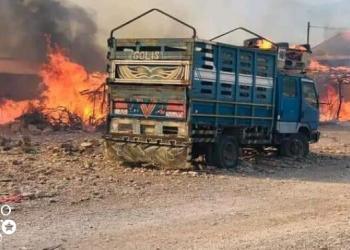
Mohamed has been forcibly evicted from 10 different camps in just two years, often without warning. He believes landowners use displaced families to raise the value of their property before chasing them away.
“This has happened many times. It’s a repeated betrayal. But we have no money for rent. We are forced to endure it,” he said.
“We decided to change this situation by contributing to the savings scheme. When the funds are collected, one person in the group takes the money and buys a plot – today, let’s give it to so-and-so. We’ve reached 35 people this way. And now, I am happy in my heart — thanks to this system I own a plot that can’t be taken from me. I will not be chased away!”
Mohamed supports his family by digging garbage pit holes, while his wife does laundry work. Their income is irregular, averaging $5 to $7 on days they find work, which barely covers food and water that cost 2,000 Somali shillings per 20 litres.
They have lived in a hut in Hilaac-wanaag camp since 2021. Mohamed said none of his children had been consistently in education due to their constant movement, although three currently attend the free primary and secondary school.
He was displaced from Doon Buraale in Lower Shabelle when drought destroyed his two-hectare farm. His immediate plan is not to return to the village. He intends to occupy the plot he now owns in Bod-bodka when he can afford to develop it, so that he remains close to the city where there are jobs.
“Every day, going into new camps and then being chased away when the land value rises to live under a tree – and then be chased again, is unbearable. We wanted to stop that life, so we came together and began this scheme,” he said.
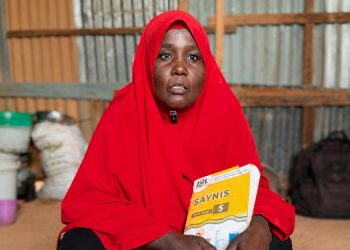
Habibo Abdi Kuus, a 50-year-old mother in the group, described receiving her official title document for her plot in Bod-bodka as a historic moment.
“It is the most important thing I’ve achieved in my three years as a displaced person in Mogadishu,” she said. “To be someone who has moved from 10 places and then hear today: this land is yours, if you want you can build your hut on it, if you want you can collect scraps and make something out of it – that means everything to me!”
None of the families have moved yet because they lack the resources to build in Bod-bodka, where there are no amenities.
The landowner in Bod-bodka is a relative of the camp leader of Hilaac-wanaag camp, which eased the negotiations. The savings group made an agreement at a notary’s office in which they agreed to pay the $5,000 downpayment for the land and the rest in instalments.
Afgoye district administration issued the group’s land ownership documents.
Habibo said: “I can’t afford construction right now, but when I finish paying into the scheme I’ll focus on building.”
Habibo is still expected to keep contributing the monthly $4.5 for her earnings of at most $4 a day working as a porter in Bakara Market and doing laundry for neighbours. Her husband searches daily for manual jobs, mostly digging garbage pits.
“Our life is one where we sometimes have something and sometimes we don’t. We eat once a day at night. In the morning, the children eat leftovers from the night before,” she said, adding that the only service in Hilaac-wanaag camp is the free Daaru Thabaad School, built by a Turkish organisation eight years ago, where four of her children are enrolled.
The new land’s proximity to Mogadishu will remain important for jobs and education, especially until amenities there are developed.
The chairman of Hilaac-wanaag camp, Mohamed Aweys Mohamed, who is himself among the displaced families, organised the initiative. Mohamed and another man covered the deposit, with Mohamed paying $3,000 from leasing out a three-hectare farm he owns to traders.
“We would have preferred to buy land in Mogadishu but it’s too expensive,” he told Radio Ergo.
“But the bus fare to Mogadishu from Afgoye is just half a dollar, so we can work in the city and sleep on our own land.”
He explained how the plots are awarded to the savings scheme members fairly through a lottery.
“You pick a paper from a bucket. If it says zero, you leave. If it says your name, you get the plot and receive your title deed. You pay $10 on the day the ownership document is issued, nothing more.
“We used to rely on land we didn’t own and were always getting kicked out. Now, we have our own land. No one can take it from us!” Mohamed said.
Many families in the camp come from Kuntu-warey, Sablale, Wanlaweyn, and Qoryoley districts in Lower Shabelle, which have all been hit hard by drought and conflict.
Mohamed himself fled Qoryooley 15 years ago after losing his farm and his last 50 goats to drought. He now leads the Hilaac-wanaag camp, with a total population of 428 families, all hoping to escape the cycle of eviction and instability.
Local organisation Somali Public Agenda conducted a case study on the Hilaac-wanaag community-led initiative, praising it as a model of collective action by minority displaced people. However, the researcher, Farhiya Mahamud Hasan, noted that vulnerable displaced people including this group were still vulnerable to evictions by greedy landowners.
She called for government support including legal protection, security, and help with full land registration or displaced people.
“The government must recognise these families. They are buying land in open spaces. They need legal assistance to ensure ownership is secure,” Farhiya told Radio Ergo.
“When displaced people can rent a house, find a job, and enroll their children in school, they are no longer just camp residents, they become part of the community.”