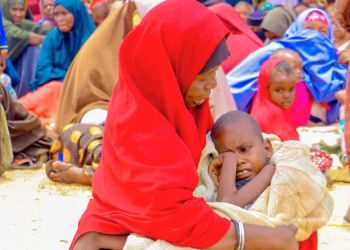
(ERGO) – Hundreds of farming families who fled villages in southern Somalia’s Lower Shabelle that have been hotly contested in the government’s war on Al-Shabab are facing a daily struggle for food and water.
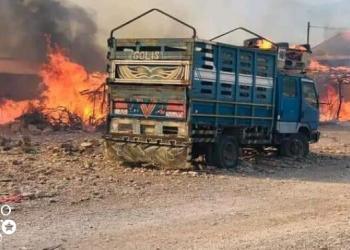
The families left villages including Mushani, Garilow, and Barire in November 2025, as fighting between government forces, African Union troops, and Al-Shabab – combined with failed rainfall – drove them to abandon their farms
Farmer Nuur Mohamed Abdullahi, 56, a father of 17, says his large family is struggling to survive in Shalanbood, 11 kilometres from the main coastal town of Merka,
“We find it very difficult to get food. Sometimes we eat only once a day. People who are better off help us with small handouts, but it is not enough,” he said.
The displaced families have settled in open areas outside Shalanbood, where sand dunes driven in off the sea have been building up and causing problems in the area.
They have put up huts built from old cloth and sticks that offer little protection from the sun or the blowing swirls of sand.
Water is a challenge, with the nearest borehole selling 20 litres of water for about 20 cents ($0.2). Nur relies on kindness of other people fetching water from the borehole, who might fill one jerrycan for his family.
“For a family as big as mine, one jerrycan is not enough,” he said. “We use it only for drinking and sometimes to cook one meal. On some days the adults stay thirsty so that the children can drink”
Nuur farmed vegetables and grains on his land. Last August, he planted tomatoes, peppers, maize, beans, and other crops, but drought destroyed them all before harvest.
He lost his entire investment in seeds, ploughing, and pesticides, leaving him with a debt of about $400 that creditors from his home village continue to demand repaid.
“They call me constantly asking for their money. All I can tell them is that I have nothing,” he said.
The crisis has also disrupted the education of his children. Ten of them were in Koranic school in Mushani, where he paid about $50 each month in fees. Since the family fled, they have been out of classes.
Schools in parts of Shalanbood have been affected by sand encroachment, while others charge around $6 per child each month that he can’t afford.
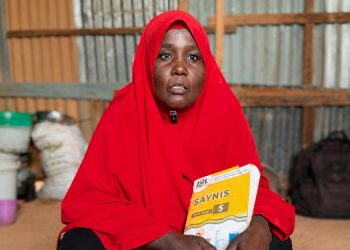
Another displaced farmer, Abdullahi Ibrahim Ali, has a family of 10 to support in these difficult conditions. His wife walks to the western side of Shalanbood, where the sand has not yet reached, to ask neighbouring families for cooked food.
Whenever she returns empty-handed, the family goes to bed hungry.
“We queue for water at a nearby brackish well,” Abdullahi said. “It is never enough for us. If we try to buy more, we cannot afford it, so we must ration what we have even for washing and bathing.”
His family lives in a fragile shack made of branches and plastic sheets given by local residents. The shelter is overcrowded, hot in the day and cold at night.
Four of Abdullahi’s children who were attending Koranic school have no classes to go to now. He fears the family could be displaced again if the sand dunes spreading across Shalanbood continue to advance.
“The sand is covering houses in the town. In some places it rises higher than the buildings, like waves in the sea. It has changed people’s lives,” he told Radio Ergo.
Abdullahi is also burdened by debts of around $330 for food and farm supplies he took from traders in Barire before fleeing. Creditors frequently contact him, but he is struggling to survive without any source of income.
The last crops he planted on his farm in October were destroyed by drought and pests before they could mature.
Local officials say the displaced families arrived in Shalanbood at a time when residents of the town were already facing economic difficulties caused by drought and the sand encroachment.
The district commissioner of Shalanbood, Nur Osman Rage, told Radio Ergo that the authorities had recorded nearly 1,000 families displaced by conflict and drought in the surrounding areas since November.
“These families are facing serious problems, especially food shortages and lack of medical care,” he said. “Many people cannot afford treatment if they become sick.”
He said the sand that has spread across parts of the district has also affected the livelihoods of residents, by disrupting farming and reducing casual labour opportunities.
“People used to depend on farm work and daily labour, but those opportunities are now very limited,” he said. “Businesses in the town are also few, so there are no jobs for the displaced.”
The commissioner added that the local authorities had informed the government and humanitarian agencies about the situation but little assistance had reached the affected families.
The conflict between government forces and Al-Shabab in breadbasket areas of southern Somalia has worsened the impact of drought on already weakened farming communities.