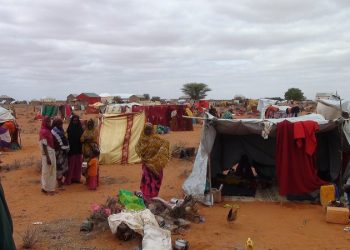


(ERGO) – A number of small women-run businesses in an internal displacement camp in Dollow, southern Somalia’s Gedo region, have closed as the community has less cash due to aid cuts.
Hibo Hassan, a divorced 42-year-old mother of eight, had a small vegetable stall in Kabaaso camp selling tomatoes, onions, potatoes, and other produce that closed at the end of July.
“The pressure I’m under can’t even be described,” she told Radio Ergo. “You can imagine what it’s like for a mother today with no husband to help, no aid agency giving support, and no relatives sending money. What little we used to depend on has all disappeared. Sometimes when others eat three meals a day, we can only afford one. Right now, I don’t have any work at all.”
Her stall used to bring in around $10 a day, enough to cover food and other basic needs for her family.
When aid agencies stopped the monthly $80 cash transfers that displaced families had relied on, her income fell sharply as her customers had less spending power. Soom, she could no longer afford to restock her stall.
Four of her children, in grades five, six, and eight, dropped out of school two months ago because she couldn’t pay the $30 monthly school fees.
“They were sent home because I couldn’t buy their fees,” Hibo said. “A child can only continue learning if they have books and a uniform. Without those, teachers don’t allow them to stay in class. So my children were sent home and haven’t gone back since.”
Hibo said the family’s monthly cash support from aid agencies had provided stability. She owes $500 to farmers for fresh vegetables supplies she received in June, as well as to other shopkeepers who gave her food and clothing on credit.
After four years of trading in the market, she says being inactive is unbearable.
“If we could get support from people who understand small business, we’d rebuild and start again,” she said. “We just need people to stand by us so we can restart.”
Hibo began her business in April 2021 with $100 savings, determined to n work to support the family after they had been forced her to flee their rural home in Geedweyne, Gedo region, in 2019.
Another woman trader affected, Sadio Omar Muse, 50, a mother of eight, closed her business in June.
“When my business was running, I earned $8 to $10 a day, that was enough to feed my children and pay their school fees. Now everything has stopped,” she said.
Customers disappeared when money stopped circulating in the camp. Sadio says she is relying on food shared by others, instead of being independent as she had been.
“There’s no business now, I have my children here, but nothing to give them. Before, we somehow managed to get by, but now there’s nothing. We don’t get three meals a day. Some days we eat, some days we don’t.”
Like Hibo, five of Sadio’s children have dropped out of school because she couldn’t pay the school fees. Since classes resumed in September, they have stayed at home.
“In the mornings, the children just wait around, they used to go to school, but now five of them were sent home because I couldn’t pay. I couldn’t even buy their books or pens.”
Sadio started her tomato-selling business in 2020 with just $20. After two years of hard work, by 2022 she managed to expand it to meet her family’s daily needs. The collapse of her business has taken her back to where she started.
According to Hassan Adan Abdullahi, head of Kabaaso market vegetable traders’ association, the crisis has affected about 50 women in the market.
He told Radio Ergo that traders in the market had pooled their own resources to help around 10 women to restart their businesses, but many others remain without assistance.
“The main reason these women left the market is because the aid stopped. Most of the customers used to rely on food aid. When that ended, they had no money to buy vegetables, and the women’s businesses collapsed. At least 50 women have left the market. As a traders’ committee, we met and said it’s unacceptable to lose this many traders in just two months,” Hassan said.
Most of the women had been in business for the past five years, hoping to become financially independent and work their way out of the camps.