

Life for Halimo Mohamed Abdi and her family has never been easy in Mogadishu, but for 14 years the pre-civil war health ministry compound was the place they called home – until it was all razed to the ground this year.
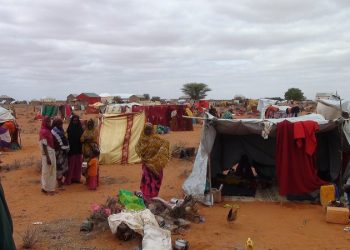
Halimo now lives in Danyar internal displacement camp, in Garasbaley on the outskirts of Mogadishu, among 120 families who were all forced out by the government’s unannounced clearance operation in July.
They share the same daily struggle to find food, water, and a safe place to sleep – let alone education for their children.
Before the eviction, Halimo worked as a house cleaner earning $4 to $6 a day, enough to feed and educate her six children. But when her neighbourhood was cleared, she lost her source of income and financial independence.
“When we lived in Mogadishu, life was much better, but what I’m living through now is extremely difficult. We have no shelter and no food. We have nothing at all. No relatives or friends help me. There’s no one who supports me,” she told Radio Ergo.
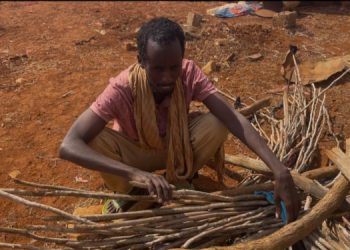
Three of her children have been sent to live with rural relatives in Lower Shabelle region because she can no longer afford to feed them. The remaining three children stay with her in a makeshift shelter of sticks and plastic sheets.
In Danyar camp, a 20-litre jerrycan of water costs 2,000 Somali shillings. Her four school-age children dropped out of the free government school they had been attending. The nearest school to the camp charges $10 per child monthly.
“I can’t pay that amount, so my children had to drop out. The schools here all require fees, and I can’t manage that,” she said.
Halimo’s family was among dozens evicted from the former central government health ministry site — a colonial-era building that had long sheltered displaced families. The eviction, she said, came suddenly and without any warning.
“They entered without informing us. The demolition began suddenly. We were not given any notice. If we had been informed, we would have made plans to move elsewhere,” she said.
She had always feared the government might reclaim the property, but hoped for enough notice to find a better alternative place than a displacement camp.
Halimo was first displaced 14 years ago from the rural areas of Marka district, Lower Shabelle region, where drought had destroyed her small rain-fed farm and killed her livestock. Like many of those now in the camp, she cannot afford to rent elsewhere within the high-cost city.
Legal experts say that while the government has the right to reclaim public land, it must do so lawfully and humanely.
Yusuf Ahmed Ali, a Somali lawyer, told Radio Ergo that forced evictions can create severe humanitarian crises for people who have nowhere else to go.
“The government must follow legal procedures when evicting residents, even if the land belongs to the state,” he said.
“People should be given prior notice and time to relocate, and authorities must ensure that the eviction does not place them in inhumane conditions.”
According to the United Nations, nearly 142,000 families have been evicted from their homes in Mogadishu since the beginning of 2025, leaving thousands stranded on the city’s outskirts without food, water, basic services – and of course deprived of job opportunities.
Among them is Rahma Abdulqadir Abdullahi, a mother of four, separated from her husband, and now struggling to survive in Danyar camp, where she has lived since June. Her shelter is made of plastic sheets and cardboard.
Rahma had been living a relatively stable life in a small home near Ex-Control-Afgoye neighbourhood, where she ran a vegetable and grocery stall earning up to $7 a day. The income supported her children’s food and schooling, until her home and business were demolished during a government clearance operation.
“The house and small business I relied on for daily income were demolished. I could afford food and pay for my two children’s schooling. But now, after being displaced, I ended up in this camp. Everyone fled in different directions — I came here. Life was much better before; now it’s very difficult,” she said.
Early in her displacement, a thief broke into Rahma’s flimsy shelter and stole the little food and clothing she had left.
“While we were sleeping, someone broke in and took our food and clothes. We woke up to find everything gone. We were sleeping in a women’s shelter without men around. He stole the food a Muslim man had donated for the children. We have nothing else — no mattress or mat even to sit on,” she said.
Rahma and her children, who had never lived in a camp before, are struggling to adapt to their new reality. She said insecurity and theft are common, especially at night, leaving her constantly anxious for her children’s safety.
For eight years, she had lived on the government owned land in Mogadishu, after fleeing drought that killed off her livestock loss in Balad district.
The Somali government has yet to announce any concrete plan to assist families evicted from public land, leaving many trapped in worsening poverty and uncertainty about their future.