(ERGO) – Farmers in Hero-Dhagahley village in Somalia’s central Mudug region have been devastated by a deadly combination of locusts and water shortage that has ruined their crops, vegetables and fruit that were close to harvest.
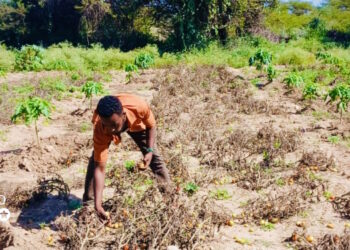
Abdimaciin Ahmed Mahmoud’s two-hectare farm produced tomatoes, onions, carrots, peppers, and lemons, among other crops. Locusts and lack of water destroyed almost everything, leaving him with losses of about $1,300.
“The locusts left eggs in the fields and the insects settled on every plant. We have been left with nothing,” he told Radio Ergo. “The biggest problem on my farm is water. The well has no working pump, storage tank or pipes, and we can’t even afford fuel. We have lost the crops as well as many of the trees that have dried up.”
People in Hero-dhagahley, in eastern Mudug, rely largely on farming for their livelihoods, selling vegetables and fruit in Hobyo, Wisil and other nearby towns.
The village well supplying water for irrigation and household use has been out of service for four months without repair. Farmers say they cannot afford to buy water transported from a private well 10 kilometres away.
Abdimaciin said they are cooking one meal a day and are finding it hard to get credit from shopkeepers. He used to make at least $700 a month from the farm that he started in 2023 with a $500 loan, after drought wiped out more than 200 goats and camels his family had relied on as pastoralists.
Today, he cannot afford water costing $5 per barrel for his family of 10 and their five goats. They have to depend on neighbours giving them a single jerrycan of water, which is far from enough.
The crisis has also interrupted his children’s education. Two children have stopped attending Koranic classes and primary school. Two older children are staying with his brother in Galkayo, who pays $10 a month for each of them to continue secondary school.
Abdimaciin owes around $600 for food and water purchased on credit during recent months. He said neither his years as a livestock herder nor his three years as a farmer had brought him such severe hardship before.
Another local farmer, Hafid Abdi Siyad, said the failure of his one-and-a-half-hectare farm had affected every aspect of life for his family of seven. The grains and vegetables he planted in February were ruined, incurring losses of around $1,200, including $800 he had borrowed to finance the farm.
“My greatest concern now is how to provide for my family. When the farm was productive, our lives were much better. Today our biggest hardship is making ends meet. The place that used to provide our income has stopped producing. Our needs keep growing, while drought has left us without water,” he said.
Hafid said his family survived on occasional support from relatives living in Galkayo and Hobyo, who sent them one or two dollars for a single meal. He also owes more than $300 to local shops, which have stopped giving him food on credit. People who financed his farm continue asking to be repaid.
For more than eight years, farming was the family’s only source of income. He said locusts, other crop pests and water shortages combined to destroy everything.
“The locusts caused enormous damage. They destroyed plants that had been growing for three months. They settled on our lemon trees, mango trees and other young plants until they dried up. There are so many of them that you can’t keep them away, day or night,” he said.
The locusts laid eggs throughout his fields. Without money and resources to clear them, they destroyed everything. Even if water had been available, he said it would be difficult to resume cultivation without wider rehabilitation.
Hafid has been looking for odd jobs loading stones at local quarries, but at best makes a pitiful $3 a week.
The family’s financial difficulties led to three of his children being sent home from their primary school in May, as he couldn’t settle four months of school fees of $160. Seeing his children lose access to education causes him deep concern. Having grown up in a pastoralist community without the opportunity to attend school himself, he had hoped his children would have a different future.
The deputy chairman of the Hero-Dhagahley farmers’ cooperative, Liban Said Siyad, said the sharp decline in agricultural production had affected more than 80 small scale farmers in the area.
“The losses have hit the poorest farmers the hardest. These are people who used to work in their fields every morning and earn a living by selling what they harvested. Now they have nothing to take to market,” he said. “The result has been hardship, financial losses and displacement. Families have lost the income they depended on every day.”