

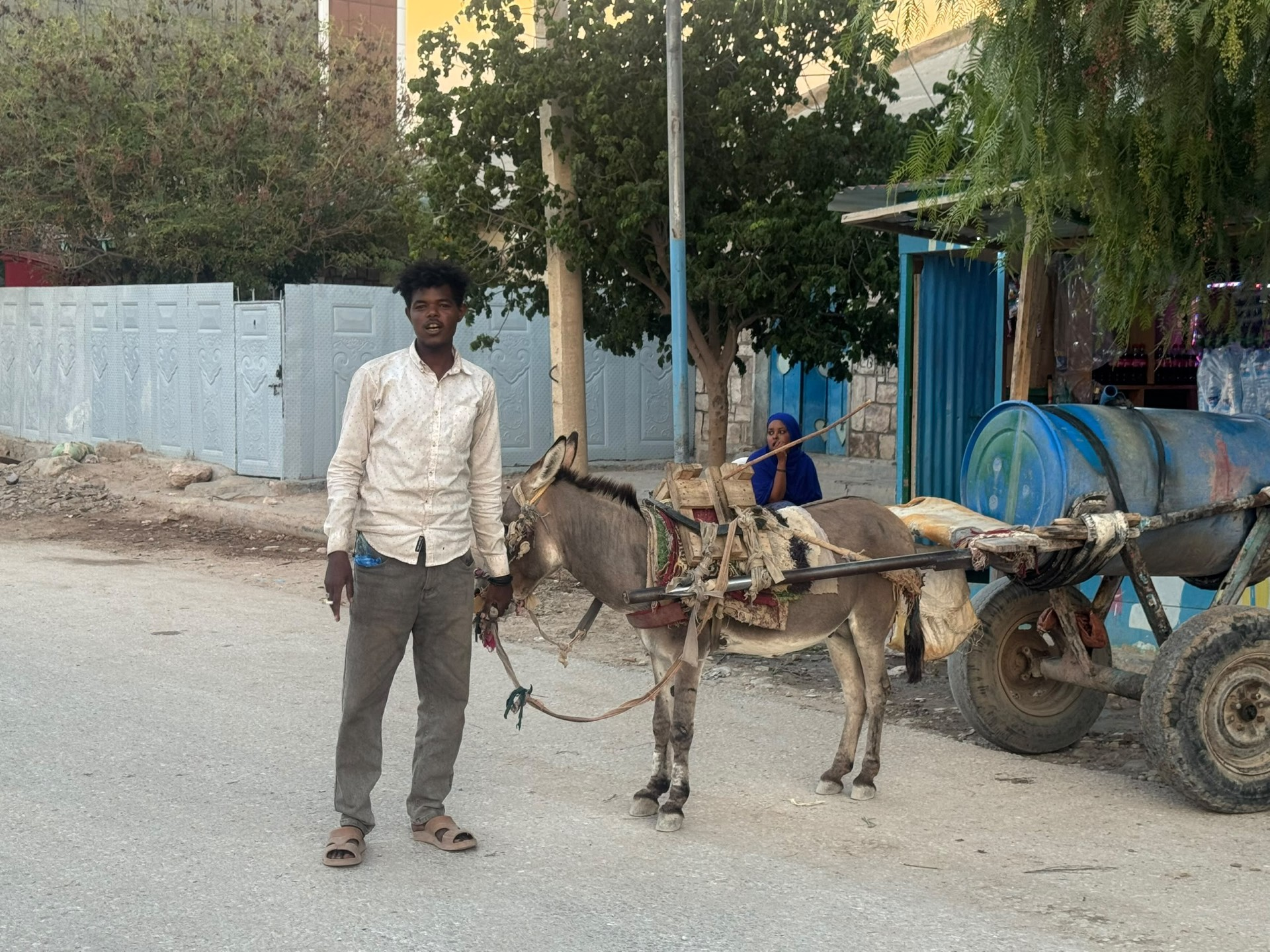
(ERGO) – Donkey-cart water vendors in the Somaliland capital Hargeisa have been put out of work by the expansion of the city’s piped water network.
Many neighbourhoods were connected to the new water system in April 2026. With taps in their homes for the first time, they stopped buying from the donkey cart vendors they had used for years.
Abdinajib Hassan Nur, one of the traditional vendors, says he now doesn’t have enough income to provide for his family’s basic needs including food, shelter, and education for his children.
The father of six said that after losing most of his customers he turned to buying food on credit, but local shops stopped extending loans after his debts reached $200.
“I had many customers and worked from morning until late in the evening. Now I might leave home at seven in the morning and return with my donkey still hungry because I haven’t delivered water to a single household all day,” he told Radio Ergo.
Abdinajib, 42, says in the past three weeks he’s earned just three dollars compared to the $30 to $40 he used to make in a day. Neighbours offer some cooked food or basic groceries, but this help is irregular and insufficient. The family’s financial difficulties have also forced five of his six children out of school.
“We live in a simple makeshift shelter that we own, so we don’t pay rent. But the biggest problem is our children’s education. The two who were still attending school are now at home because we simply couldn’t afford the fees,” he said.
Abdinajib has depended on his donkey cart for a living since 2019. The cart carries a 300-litre tank fitted with a hose used to fill storage containers in customers’ homes. He is worried about the condition of his donkey as he can’t afford enough feed:
“The donkey is suffering the most. It’s a living creature that needs grass and food. Without food it can’t pull the cart properly. Sometimes I can’t even find fodder for it.”
Abdinajib and his family migrated to Hargeisa seven years ago after drought their livestock in Harshin village died due to prolonged drought. He turned to selling water in the city.
Another donkey cart water vendor, Mohamed Ali Rage, was ordered to leave the rented house where he lived with his family of eight after falling two months behind on rent, owing his landlord $50. Their electricity was disconnected two months ago because they couldn’t pay the bills.
Mohamed used to earn more than $20 a day transporting water by donkey cart, which has been his livelihood for 15 years. He has no other skills to fall back on, and his children now depend on neighbours and relatives for food assistance.
He continues touting for customers, but finds only the odd café or household needing occasional water delivery once a week. He used to supply water daily to 15 to 20 households, most of which are now connected to the municipal water system.
His family were also pastoralists, who were displaced from Balli-Abane near Hargeisa in 2013 after repeated drought destroyed their livestock.
Meanwhile, Siciid Abdi Jaama, who owns a private water point, said nearly 100 donkey cart vendors used to buy water from his business. Today, fewer than 10 continue operating, and many of them take water on credit because they can’t pay in cash.
“Their earnings have fallen dramatically by about 90 per cent. Only a handful are still working, and those few can’t support their families or even feed their donkeys. They are among Somaliland’s most vulnerable communities and deserve attention,” he said.
Siciid noted that some vendors had continued transporting water to remote rural villages not served by water tankers, where demand had not been affected by the city’s expanding piped water network.
Whilst the modernisation of the city’s water supply has improved life for many residents, Hargeisa’s humble donkey cart vendors symbolise those left behind by such development, without alternative ways to support their families.