(ERGO) – Establishing a water storage system that promises better water access in a perennially drought-hit part of southern Bay region has also brought welcome employment for impoverished displaced families.
The water project that began in Qansahdhere district in July has given manual labour jobs to around 1,260 people, enabling them to earn $80 a month to support their families.
The water storage facilities, comprising of three water pans and one reservoir, will have a total capacity of 3.6 million litres of water. The project aims to create sustainable water sources for the community that can be used during the dry seasons, according to the implementing agency, MARDO.
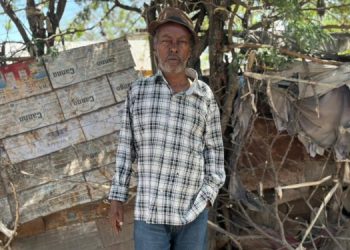
The money that Osman Ali Hassan, 39, earns as a labourer digging the pans has allowed his family to afford enough food.
“Our lives are much better now – we used to cook once a day, but now we cook three times daily. I dig the water pans for three to four hours every day. I thank God because our lives were very difficult, but now things have improved,” Osman said.
He sent three of his six children back to school in August, paying $10 a month in fees, and no longer worries about how to provide for his family’s daily needs.
“If things continue this way, I hope to start a small grocery business,” he said. “We had nothing – we lacked food and water, and our children often went hungry. But now life has changed, the children are happy, and this project has truly transformed our lives.”
The family has been getting water from a hand-dug well four kilometres away, paying 4,000 Somali shillings for a 20-litre jerrican.
Once the new water facilities are completed, the water will be freely available. The project site is about three kilometres from Buufow, the internal displacement camp near the town where they are living now.
Osman migrated to Qansahdhere in 2018 after drought wiped out his 100 goats in the rural areas. He says the camp has no basic services and there have been no jobs available.
A 13-year siege by Al-Shabaab on Qansahdhere was only lifted in April 2025. The opening up of the district has allowed new projects like this one to begin.
Mumin Ishaq Ali, 36, also earns $80 a month to support his family of six.
“We can now cook three meals a day, my children are back in school, and I pay all our expenses without stress. Before, we often went the whole day without food. That’s how bad it was, but now we’ve recovered,” he said.
Mumin was jobless for three years, relying on relatives and neighbours for meagre support. Now he has re-enrolled two children in school after a gap since 2023 because he couldn’t afford the $8 monthly fees.
He managed to clear the $70 debt he had accumulated for food taken on credit at local shops. He has already saved $50 towards starting a small business when the project ends.
His family was displaced in 2022 from remote areas on the outskirts of Qansahdhere after drought wiped out 90 goats and dried up their three-hectare farm. They came to the urban area to find no assistance or opportunity.
The head of Mandhere Relief and Development Organization (MARDO) in Bay region, Mohamed Abdirahman Mohamed, said the project aims to provide a long-term solution to recurrent water shortage.
The two-year project is being implemented jointly by MARDO and the UN’s World Food Programme (WFP), with the South West regional administration.
“Our goal is to help the community achieve self-sufficiency. As you know, water scarcity is widespread during hot seasons in South West regions, especially in Qansahdhere. We want to improve water access and find a lasting solution to this persistent problem,” he said.
Qansahdhere district has an estimated population of around 80,000 people, mostly pastoralists who remain vulnerable to climate shocks that reduce pasture and water availability.
As the district has no boreholes, residents reliant largely on agriculture and livestock production depend on shallow hand-dug wells that often dry up in the dry season, leading to consistently high flows of people moving away to seek assistance in displacement camps.