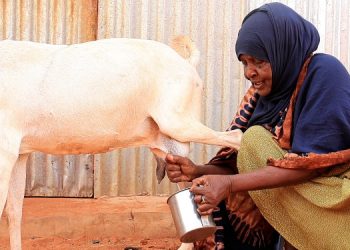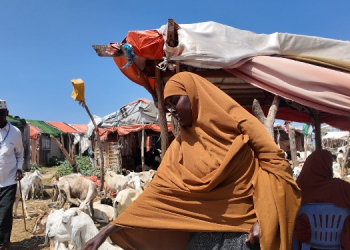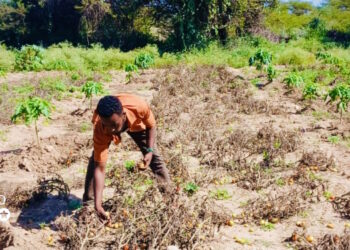


(ERGO) – Hundreds of pastoralist families who fled conflict between Somali government forces and Al-Shabaab in Aadan Yabaal district have been abandoned to their fate on the outskirts of Warsheikh, Middle Shabelle region, since June.
The families had to leave their homes and livestock behind when the conflict escalated and they fled for safety. They are now facing hunger, water shortages, and lack of shelter, having lost their livelihoods and source of income, and with no signs that help will come.
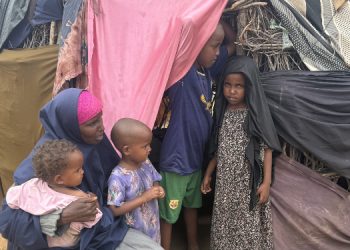
Madino Ahmed Mahmoud, a mother of five, is raising her children alone in Horseed displacement camp, four kilometers from Warsheikh town.
They fled their home in Adan Yabaal with only the clothes on their backs, leaving behind their 20 goats and three donkeys that were too weak to survive the long 160-kilometre trek to Warsheikh.
They walked for eight days to Adale, 87 kilometres from Adan Yabaal, where they got a free lift the rest of the way to Warsheikh.
“We survive by cooking once a day. My children don’t get lunch or breakfast. Whatever little we receive from others isn’t enough, but we have no other choice. We are displaced people with no work. The fear of conflict is gone, but now food has become our biggest worry,” said Madino.
Her family relies on occasional help from relatives in Mogadishu.
In the camp, they beg for 10 litres of water a day from a privately owned borehole nearby. They take turns appealing for water since they can’t afford half a dollar to buy a 20-litre container.
They live in a fragile hut made of sticks and pieces of cloth that gives little protection from the cold and rain in the current deyr season.
“Our previous life was good. We lived comfortably with our few animals, had a nearby well, and used to fetch water with our own donkey cart. Now we’ve left everything behind. Only our lives were saved,” Madino said.
The conflict destroyed her two-room house, kitchen, and toilet. Two of her children have dropped out of Koranic school because she can’t pay the $4 a month in fees.
Madino has searched unsuccessfully for cleaning jobs around Warsheikh to earn some income. Like most displaced people in the camp, she depends on small donations and help from well-wishers.
In the same camp, Sahra Mahmoud Mohamed, 47, is caring alone for six children with no stable source of food. She told Radio Ergo she cooks once a day using food she collects by begging in Warsheikh.
Her youngest child is just three years old and cannot bear long hours without food.
“We don’t have enough water for daily use. We fetch what we can carry on our backs. We don’t know anyone here — we just go door to door asking for help, and kind people support us out of faith,” she said.
Sahra said they fled the clashes leaving behind 40 goats – their only wealth. She had penned them before fleeing and has no idea what became of the animals.
Three of her children have been out of school since their displacement. She used to pay $6 per month for their schooling, but now she can’t manage that. Schools in Warsheikh charge about $3 per child per month, a cost beyond her reach.
She owes $300 for food and water she bought before fleeing, which creditors still demand though she has nothing to repay with.
“We walked for 40 days before reaching here. We couldn’t find transport or rest anywhere on the way. We suffered from hunger, thirst, and exhaustion,” Sahra recounted.
This is her first time in displacement, and she had hoped for stability and safety in the camp. Instead, she has found deeper hardship.
The sudden displacement from Adan Yabaal has left hundreds of families in a desperate situation, having lost all means of livelihood, living day to day and uncertain of where their next meal will come from.
The chairman of Horsed camp, Abdi Yalahow Mohamed, told Radio Ergo that the conditions in the settlement were worsening as new arrivals continued to pour in.
“The numbers are increasing daily. More people keep arriving unexpectedly. The camp is overcrowded, and there are no health services or clinics to monitor their condition. We fear possible disease outbreaks. The situation is dire,” he said.
He added that over the past four months, more than 500 families had been registered after fleeing conflict in Adan Yabaal and surrounding villages. Limited resources, lack of healthcare, and the growing population have strained the camp’s already fragile conditions.