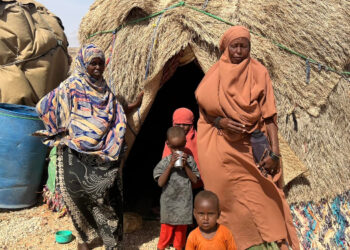


(ERGO) – Displaced women in the central Somali town of Dusamareb are collecting discarded plastic bottles and selling them for recycling. The income has become important for them in the absence of other sources of livelihood.
Hawo Anod Nur, a 49-year-old mother of nine, covers her family’s food and water needs entirely through the sale of plastic bottles to local businesses that are recycling them. The businesses pay one dollar for 10 bottles and she is making up to $100 a month from her work.
She walks the town’s streets and alleys, moving between houses, restaurants, hotels, and garbage collection points in search of the plastic.
“I’m better off now than when I had nothing. I live on my own earnings and send money for my children’s expenses. When I was jobless, we couldn’t even afford to get one meal for my family. Once I started working, life became better for us,” Hawo told Radio Ergo.
She had spent four years in Adado where a monthly $85 cash aid transfer that had supported her for more than a year ended in June.
She decided to leave the children behind in Badbado camp in Adado and move to live with relatives in Dusamareb, where she heard from other women that collecting waste plastic bottles was profitable.
“It’s been three or four months since I last received the cash assistance, and we’re still waiting. I used to buy firewood with that money. When it stopped, I moved because hunger drove me out. There was nothing left for me in Adado. I have no one to work for me, and my children’s lives depend entirely on me,” she said, adding that separating from her children was painful but financially necessary.
Hawo was displaced from Wajid district, Bakool region, in 2014 after drought destroyed her three-hectare rain-fed farm. Since then, she has lived in displacement camps in Abudwak, Adado, and Galkayo.
Nearly 100 women living in Arladi, Amano, and Shabelle displacement camps near Dusamareb have been attracted to this work collecting plastic in the town.
Naima Mohamed Ibrahim, a divorced mother of seven, said laundry jobs had become scarce and this income has helped her feed her children and put three of them in school.
“I am able to pay school fees and meet their daily needs. I came up with the idea myself after seeing how badly we needed it,” she said.
Naima earns $70-90 a month, which she uses for food, water, and other essentials. Her family lives in Shabelle camp, a 15-minute walk from Dusamareb. The camp housing 250 displaced families has no access to free services. Residents pay $0.50 for every 100 litres of water from a nearby borehole.
“We couldn’t even afford one meal a day,” she said. “Now my children no longer go hungry.”
Naima has built up a network of restaurants and householders, who call her to come to collect the plastic bottles that they have saved instead of throwing them out.
Her family was displaced in 2022 from the outskirts of Kismayo after three consecutive failed rainy seasons wiped out their two-hectare farm. The loss left them destitute, and after moving north to Galmudug, they relied on odd jobs.
Fartun Said Ahmed, whose family fled Harardhere district in Mudug region after drought killed their herd of 30 goats last year, the up to $90 she makes a month has been a lifesaver. She’s saved $100 by putting $30 aside each month.
She has managed to move her three-member family out of El-Hamud camp, where they had lived for a year, into a small hut in Dusamareb rented for $10 a month.
“I want to start a small business and take my children to school. Our life now is much better than when we first arrived,” Fartun told Radio Ergo.
The local businesses buying the plastic bottles from these women clean them for re-use selling water.