

(ERGO) – The closure of two schools, and imminent closure of a third, near Miirjiicley, in a remote part of central Somalia’s Galgadud region, has left dozens of children from poor families without prospects of an education.
Two of the schools, which were set up under trees due to lack of classroom structures, closed in the villages of Lanbur and Jeerinle in January, leaving 183 children and their parents disappointed and frustrated.
The schools were set up in 2023 by four local teachers, who ran them as volunteers and didn’t charge any fees to the families. They began the initiative with $1,350 that they had collected among themselves, but have since run out of funds for basic school supplies and transport.
Shukri Ali Hirsi’s six children were attending primary classes from grades one to four at the school in Jeerinle, and she had hope for their future.
“Even though each of my children could write their names and had ambitions, the school was shut down. When the schooling stopped for them, I couldn’t take them anywhere else due to financial hardship, and I can’t afford to move to the town. I wanted to send some of them to other places for school, but haven’t been able to do so,” she said.
Shukri, who lives in Jeerinle, 15 kilometres from Miirjiicley, said parents in the village tried to collect money among themselves to enable the school to continue for their children but they failed as everyone is hard up for cash.
“My kids keep asking ‘has the school stopped for us like this, or will we get it back?’ When it started, none of my children knew anything, but they are now learning to read after only attending for a short time. Now they have their books and say they will walk to Miirjiicley due to the pain of not being in school and having nobody to teach them,” she said.
In the last dry season, her family lost 100 of their 150 goats and the 50 remaining animals have a suspected lung disease that has made them sick and unproductive. Her two pregnant goats didn’t sell for much and she can’t find any casual jobs in the village.
Like many struggling pastoralists in the area, is worried about getting enough food for her family of eight. They cook once a day with a limited supply of 15 kilograms each of sugar, rice, flour, and five litres of oil that she took on credit from a shop in Miirjiicley.
“We alternate days when we have lunch and days we have dinner. Sometimes they get a cooked meal, other times they don’t. We don’t rely on anything except these livestock, which were affected by the drought. The few goats I had were decimated by the drought, and we are even in debt. I am faced with shame and people telling me to hand over the livestock to them,” she said.
Shukri has a debt of $2,000 for food and water ought on credit for the family several times over a year. Neither she nor her husband, who is elderly and unable to do manual work, have other skills.
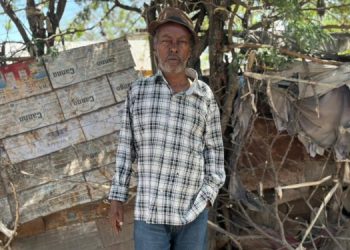
Ahmed Osman Mohamed had seven children in the school in Lanbur, where he had hoped they would do well. It was the first time his children had the opportunity for an education. He and his wife had never been to school.
“It’s really worrying for me as a father seeing my children sitting at home and not learning. That is very concerning to lose their education. Anything can happen because they are not learning. I feel a decline, but I tell them to be patient and that things will return to normal,” he said.
Three of his children were supposed to advance to middle school this year.
Supporting his family of 15 people is very hard at the moment. He said 38 of his 50 goats died last year due to a combination of lack of pasture, water scarcity, and diseases, leaving 12 small sickly animals. They cook a limited amount of food once a day, which he obtains through credit and begging.
His wife recently gave birth so Ahmed carries 20-25 litres of free water back from a well eight kilometres away that belongs to a relative.
“People are struggling with life. We can’t afford to pay for education. There has been a serious drought. Everyone is thinking about how their children will survive. All the people living in the area are the same, with financial hardship and difficult conditions. The livestock that died and those that survived don’t produce milk that fed people, because they went through a drought,” he told Radio Ergo.
Ahmed has debts of $800, which he has no way of paying. He has always lived in a rural area and has no skills to work in other jobs.
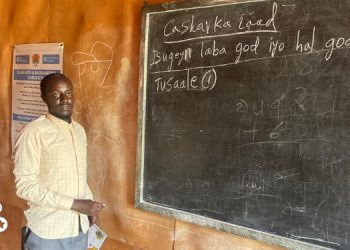
The leader of the group of teachers who set up the schools, Sultan Mohamed Abdullahi, said they couldn’t raise the $112 a month needed for educational supplies and transport for the teachers at the two schools in Lanbur and Jeerinle.
“We have kept them going for a while, and we reached out to the government, ministries, and NGOs, but we haven’t received any help from anyone,” he said,
Their goal had been for children from poor families to get the same education as those from well-off families. However, Sultan said that 70 of the disappointed children were due to advance from primary to middle school this year.
He warned that the third school with 119 students in Lan-alen village could also close. As this school is near to Miirjiicley, the teachers can walk and don’t require transport funds.
But there are no teaching supplies and no school building, with wind and dust making conditions unconducive.
“It became difficult for the classes to continue because the dry season started, and it wasn’t possible for the students to study in an open area. We need benches, classrooms, teachers, and money, because the number of children has grown,” Sultan said.