(ERGO) – Farmers in north-eastern Bari region of Puntland are reeling from a series of devastating climatic events – compounded by ongoing conflict in the area – that have left them at risk of not being able to recover their livelihoods.
In April, heavy rainfall led to flash flooding in Doha-gibin that washed away the crops and property of local farmers.
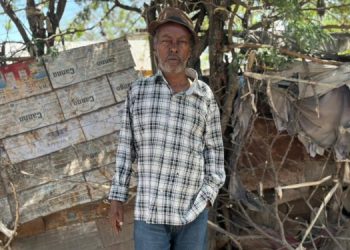
Among them, Abdi Ali Mire’s two hand-dug wells that he used to irrigate his farm were badly damaged. He lost their food stocks, their utensils, and all the onions, tomatoes, bell peppers, watermelon, millet, and maize that he was close to harvesting.
The damage to the water wells that he hasn’t managed to repair meant that seeds he planted in May withered and died due to lack of water.
“The rains were heavy and washed away all the crops we had on the farm. After that we were struck by water shortage that ruined the other crops. Nothing was left of our equipment after the flooding, only one bucket and one spade remained,” he told Radio Ergo. “The seeds were also washed away.”
Abdi’s family came to Doha-gibin in 2023 after livestock diseases killed off their herd of 30 goats. They turned to farming and Abdi took a $5,000 loan from Amal Bank in Bosaso to buy a 1.5-hectare farm plot, dig two hand-dug wells, and install a water pump, and other equipment. All that is now lost. The 70 sacks of onions he had harvested at the end of March were also destroyed.
He bought some food on credit that they use to cook sparing meals.
“There is a strong challenge in getting food; when breakfast is available, there is no lunch. There is widespread food scarcity. It’s a tough situation, and we have not received any help.”
Abdi, his wife and eight children are sharing accommodation with relatives in town as their two-room iron sheet house also.
He can’t afford the $60 a barrel charged by water tankers from Timirshe, more than 60 kms away at the foot of the Al Miskat mountains, so he and his wife walk 40 minutes to draw three jerrycans of bitter water from the nearest well.
His children had to drop out of their primary and intermediate school in May as he couldn’t pay the $135 monthly fees.
“Education requires money from your pocket, for Koranic classes or school. I had nothing and was arguing with the headteacher every day, so it was better to take my children out. With no income, me and my wife and children face each other that’s my biggest burden, the debts on me,” Abdi said.
This part of Somalia has been the focus of intense fighting to rout out ISIS, or Daesh, led by the Puntland forces backed by foreign powers with air bombardments.
Meanwhile, Yurub Ali and her husband, who have been farming for 10 years in Doha-gibin, have had to rely on occasional small assistance sent from relatives in Armo, or go without. None of the vegetable and food crops they had planted in January survived the flooding.
They used to harvest their two-hectare farm two or three times a year.
“The farm was what we depended on for our living,” she said. “The heavy rain destroyed the land and took away the farms and all the crops and seeds, and turned other areas into a riverbed, even washing away the structural supports from our houses.”
She said the hired farmworkers in the area, mostly from southern Somalia, had all runaway when the war against ISIS started, so they had no support in diverting the floodwaters and keeping them at bay.
On top of all this, Yurub said the watermelons and cantaloupe melons that they replanted after the floods were eaten by insects in May.
Her seven children sometimes can’t sleep for hunger.
“Food for the people is a difficult challenge for us, as is the children’s education. We used to earn our daily living from the farm, and there is no one to help us, only God can solve the problem,” she said.
The area has already had an influx of families displaced by the conflict in the mountains. Now they are all alike facing shortages of food, water, shelter and other basics.
“There are women, elders, children, and weak people here. They are just sitting around; they don’t even have a Koranic school, and all these things need money,” Yurub said.
The chairman of Doha-gibin farmers’ cooperative, Ahmed Ali Dahir, said 150 farming families had been affected by the April torrential rain and flooding and they hadn’t received any assistance.
“Without money, those affected can’t recover from this. Before the rainstorm hit us and destroyed our farms, we had suffered from a long drought. The farmers are all affected in the same way. An insect infestation also hit us, and we couldn’t get pesticides. We need those who can help us now with water and farming equipment,” he told Radio Ergo.
The chairman said neither the local administration nor any humanitarian organisations had visited their area. Many of the farmers had previously lost their livestock to drought and didn’t have any financial reserves to help them recover again from disaster.