

(ERGO) – Families living in Qurdubey displacement camp in Dollow say the allocation of cash aid to less than 10 per cent of the camp’s population is forcing everyone to eat less, as the resources are being shared among many other relatives and neighbours.
Only 700 of the 8,000 families in the camp in southern Somalia’s Gedo region have been selected to receive a monthly $55 cash transfer provided by the UN’s World Food Programme (WFP).
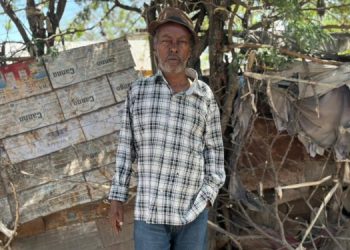
Mohamed Mohamed Sahal, 75, is not on the list of beneficiaries for this aid that began in May and is set to end in October.
When a beneficiary family he knows buys food, they give him some flour, rice, pasta and cooking oil. When that runs out, he goes out begging.
“A family from my neighbourhood received their cash yesterday and shared a few kilos with me. I then got some cooked food from a relative, just plain rice with nothing added, no vegetables, no other ingredients. The children eat that plain rice for one meal,” Mohamed said.
Whatever raw food, cooked food or coins he gets from begging, he brings home to his wife and six children. Some days he returns empty handed.
This former construction labourer has had no paid work for seven months, and the last assistance he received was an $85 WFP cash grant in 2023.
“From the first month of this year up to this seventh month, I haven’t found any work, there’s no activity going on. Now my children and household are worse off. I have no livestock, I am destitute. I am just that father living there doing nothing!”
Mohamed lost 62 goats and 11 camels to drought in Bakool in 2022 and came to Qurdubey hoping for a better life. They live in a flimsy plastic sheet shelter that offers little protection.
“In life food and shelter are the most important things. At night we face cold, and during the day the sun melts the plastic sheeting on our house. The traders in this camp, from whom I used to take goods on credit when I was working, have now refused me due to my lack of income. Therefore, this month we are in, July, is the worst for us, and we are very weak,” he told Radio Ergo.
Among the 700 registered beneficiaries of the WFP cash aid is Sahra Omar Abdi, 41, who supports seven children. She bought 55 kg of rice, flour and sugar, some pasta and three litres of oil with the last transfer and shared a portion with two neighbouring families.
“Our religion says you shouldn’t while your brother is hungry, it’s not even part of humanity to ignore a needy person,” said Sahra.
Her own household runs short of food before the month ends, and she cannot afford school fees for the children.
“Whoever complains is told it will get worse – so we don’t want to complain too much. What we were given helped us, but a small amount of aid doesn’t solve a big problem permanently. If out of 100 people in the camp, 50 are helped, the rest are still needy, they are suffering. That’s why we need more aid,” Sahra stated.
Sahra used to sell khat inside the camp but her business closed up last December when suppliers demanded cash up front and she couldn’t pay.
Before coming to Qurdubey, she ran a shop in Rabdhure, Bakool, which closed in 2022 after drought drove her pastoralist customers away, leaving her with debts of more than $2,000.
As a coping mechanism, Abdullahi Mohamed Jire, aged 74 and disabled in both legs, sent his six children away to live with various rural relatives in March because he could not feed them.
“The children have been here for five months with nothing – isn’t that reason enough to disperse them? I’m living on the generosity of other families. If hardship could help, I’ve already endured plenty. If I spent the whole day recounting our problems, we would die of thirst before I finished. How can children – alive but with nothing, and a father too weak to provide – possibly remain here? I asked which of our relatives could take a child and then turned to people for help; everyone rushed to assist,” Abdullahi explained.
“My own situation isn’t that good. I survive on getting one cup of tea from that family, a cup of tea from another, or a piece of bread. If it’s not available, then it’s not. I have no other way, I can’t beg around and I can’t work. So that’s the problem, I’m living as a dependent on other families and well-wishers, and most of them have nothing themselves.”
Camp leader, Abdullahi Hassan Ahmed, said that households judged most vulnerable qualified for the six-month WFP cash aid. He fears hunger will worsen when the payments end.
Clearly, however, many who are extremely vulnerable were missed. There are also many people who have lived for months in the camp who have never even been registered.
Qurdubey has no school or clinic. Water is the sole free service, trucked in by aid groups. Most residents living in the camps were livestock herders or farmers who lost everything to drought and conflict.