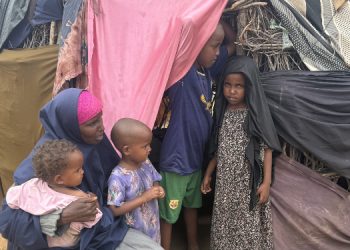


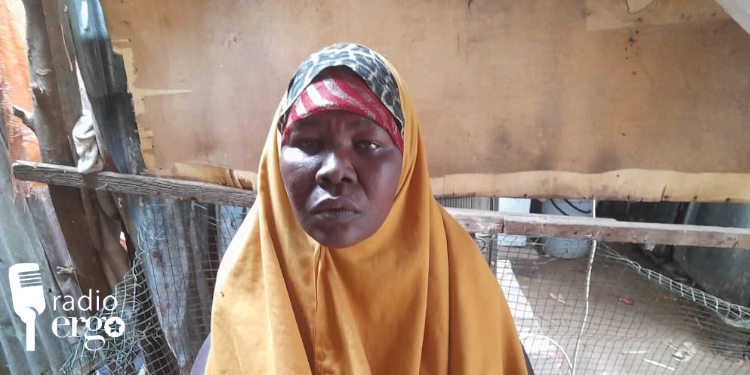
(ERGO) – Mother of 10, Khadija Mohamed Hassan sits beside an unlit cooking fire in Hilaac Wanag camp as her children wait for breakfast that may not come.
Recent heavy rainfall in Mogadishu turned this internal displacement camp in Garasbaley district into a mud bath and ruined the outdoor business activity that women like Khadija depend on in their fragile lives.
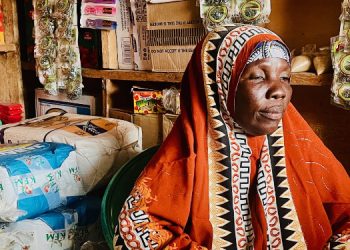
She’d been making a couple of dollars a day selling samosas and vegetables from a roadside table that was enough for two meals.
But flooding, mud, and the generally poor infrastructure that leave her victim to the vagaries of the weather have made it impossible to sell anything.
“I’ve been bringing whatever I have to sell outside but I’m getting nothing. Things haven’t sold because it’s been raining all the time and everything was ruined. The last time this happened I just had to eat what was left of the supplies I was going to sell to make a living, so now we in a vacuum,” she said.Her youngest is a baby of three months, whose father has no work. A $200 aid grant allowed her to start the stall, and she once cleared $8-9 a day. Now the family faces its worst food shortage yet.
“At night, I cook once or not at all. If I do it’s a desperate single meal. If the children are hungry before nightfall and there is no food, I tell them to drink water from the tap. Before the heavy rain we had three meals a day and helped each other out but now the situation is more difficult for everybody in the camp.”
Khadija fled her home in Janale in Lower Shabelle in 2019 because of a land dispute in which her first husband and father of their five children was killed. She lost possession of their two‑hectare farm and had to bring the children to Mogadishu.
School has stopped for the children now though as Khadija can’t meet the $15 monthly fees.
“The teacher sent the children away due to lack of tuition fees. I took them back, and he sent them away again. The teacher keeps asking for his money and I don’t have anywhere to get it. The teacher tells the children to stay at home, or get the money from your mother. I don’t have it…where would I get it from? The neighbours’ children have their fees paid, and my children’s hearts are breaking when they stay at home, so I have to keep pleading with the teacher,” she said.
Habibo Ali Mahmoud, who supports eight relatives in Hilaac Wanag camp, tells a similar story. A well-wisher’s $100 donation helped her set up a small samosa trade.
Habibo’s family was displaced by conflict from Mahaday district, Middle Shabelle, in 2023, and fled to the camps. But living conditions and her business are not robust.
“After the rain our toilet collapsed, and our houses collapsed. At night now we’re sleeping outside. The lack of a toilet is a big challenge for us, as women can’t go outside at night. We face a lot of hardship here.”
She tried to keep going with her business despite the downpours, but without any premises to trade in it’s a hopeless task.
“One day I made samosas, and then it rained on me, and I lost everything. We’ve experienced a big decline. I used to make 500 pieces a day and now can’t even sell 100. The rains have had a big impact on us.”
For Maryan Mohamed Hassan, a mother of six, even after more than a decade in the camps making a stable living still remains elusive.
She makes home‑made ice cream that covers food and rent in the good weather, but now that it’s turned cold and rains nearly all the time, there is no demand for her product.
Maryan has moved through various displacement camps in Mogadishu since 2016, when drought killed her family’s herd of 94 goats in Dinsor, Bay region.
“This month’s rains have caused us great hardship. If I take the ice cream I made at home to sell outside, there’s no one buying. Right now, we just survive on water. I used to feed my family from ice cream sales, but now I have nothing. I heat water for them to drink. Neighbours bring us one meal, and they too are surprised by our bad situation,” Maryan told Radio Ergo.
She owes $50 to the shops that supplied her ingredients for the ice cream and also has built up a further $200 tab for household expenses.
“Every day when things become tight and I don’t have anything for the children, I go out and take more food on credit from shops in the area. Then again, I go out and get more…That’s how I’ve got into such debt, and I have no income to pay off the debt.”
Camp chairman, Mohamed Nur Mohamed, says about 400 women have lost their income during this season’s rainfall.
“Most of these women had small businesses, but when they ran out of options, they consumed what they had as a business. Today, they can’t afford water, they can’t afford electricity, and they can’t afford food. They are facing a very difficult situation,” he stated.