

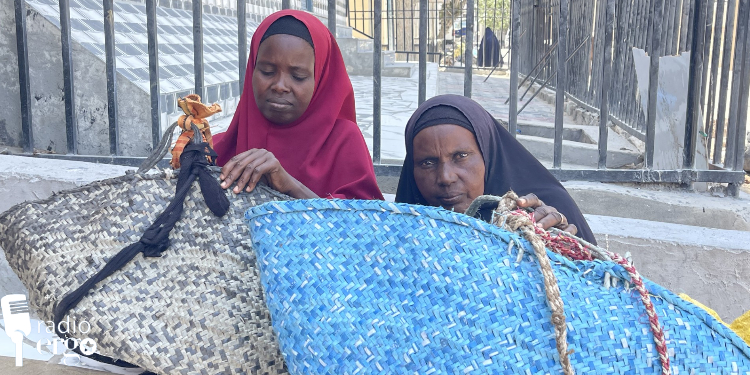
(ERGO) – A growing number of displaced women in Mogadishu are taking up physically demanding porter jobs in Mogadishu’s Bakara market to support their families, after losing their livelihoods to drought and conflict.
The work carrying heavy goods for traders and customers offers small daily earnings that are often the only available source of income in the city’s low-income settlements.
Fadumo Mohamed Ali supports a family of 10 through porter work she began in December 2025, earning between $4 and $5 a day.
“I am a mother trying to support my children, struggling every day. We get to cook meals at home, but my income is not much. People pay me small amounts like $0.25, $0.50, or $1, and I collect my income to buy rice, oil, and meat for my children. I feed them regularly. I do not beg from anyone, my children live from my sweat,” Fadumo told Radio Ergo.
Her elderly husband has long been bedridden due to diabetes, leaving her as the sole provider. Part of her earnings goes toward buying his medication.
“I used to walk around the city looking for small laundry jobs or collecting plastics to sell, but I earned very little. Now, sometimes people even give more than the agreed amount, and that helps me manage many needs,” she said.
She has built a small network of customers and sometimes delivers goods beyond the market, increasing her earnings.
Fadumo and her family settled in Garas-Baley in 2023 after losing their farm near Marka, Lower Shabelle region, due to poor harvests. Like many residents they lack access to piped water and must buy it from a private well about 20 minutes away.
“One jerrycan costs 1,000 Somali shillings. We are a large family, so we need a lot of water. When washing clothes, we may use up to eight jerrycans. If I don’t have money, I take it on credit and repay it after I work,” she said,
Despite the challenges, she has managed to pay $12 a month for four of her children studying in Koranic school.
Raho Hassan Mohamed also reports progress in meeting her family’s basic needs since January as a porter earning $3.5 to $4 a day. She supports a household of 11 people.
“With what I earn, I manage. I buy rice for the children. If I cannot afford meat, I cook it with tomatoes or other substitutes. That is how we survive. We cook twice a day, and the leftovers from the evening are eaten in the morning. Being able to cook for my children without begging from others means a lot to me,” she said.
Raho‘s husband, a former farmer, has been unable to find work since they arrived in Mogadishu, where he failed to find portering jobs himself.
Her income allows her to buy water regularly and support her children’s education.
“We were struggling, but now we are recovering. A woman helped me find this work after seeing our situation. What I earn cannot be saved, but it helps me take care of the children. Three of them are now in school, and I pay $6 a month,” Raho told Radio Ergo.
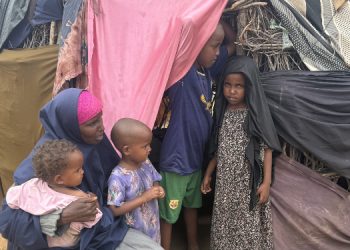
The family live in a makeshift shelter in a displacement camp in Garas-Baley, where they settled after fleeing conflict in Qoryoley district in Lower Shabelle late last year.
Barwaqo Osman Mohamed, another porter, says the work has enabled her to provide consistent support for her six children.
“When I am well and can find porter work, I can provide. Neighbours used to collect food for us but now I have learned the work and support my children. When I came from the rural area, someone showed me where to find work in Bakara market, where. I carry loads of up to 50 kilograms, like crates of tomatoes, and deliver them to different places,” she said.
Barwaqo, 37, supplements her income with laundry jobs for $4, making her weekly income total a reasonable $20-25. Her family was displaced from rural Afgoye in November 2025 due to a combination of drought and conflict.