

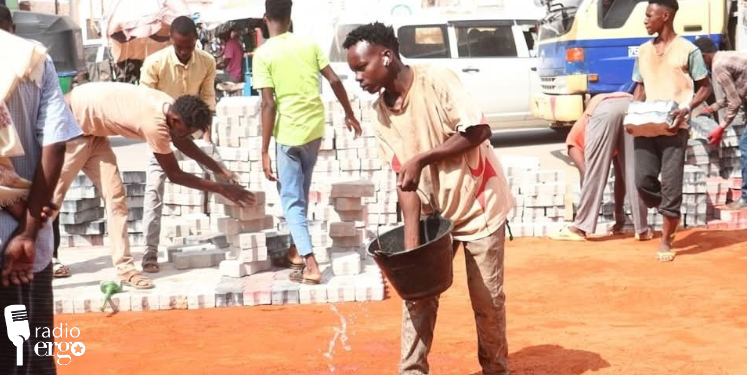
(ERGO) – A civic project underway to pave roads and marketplaces in Galkayo, Mudug region, is providing welcome paid work to about 250 men displaced or impoverished by drought.
Mahamud Ali Ahmed began loading and carrying paving bricks in April, earning $10 to $15 a day.
“If not three then we mostly get two meals a day now. The money I am earning buys daily food, brings provisions to the house, food, sugar, everything. I had an outstanding bill at the shop and I’ve pai off one month’s worth as well as other small debts. This job has helped me a lot,” he said.
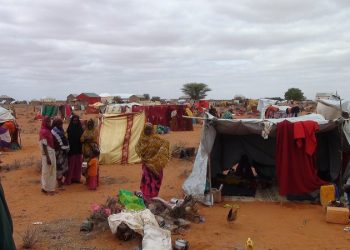
Mahamud’s family arrived in Galkayo last October after two years of drought killed 130 goats they kept in Dollow, in Ethiopia’s Somali Region. They had to rely on poor relatives who shared meagre food and shelter while Mahamud searched for work.
“I started life from scratch, as I wasn’t a man who had learned a skill before, and it was difficult for me to learn a trade or craft. I also lost a lot of money in a trial-and-error business to get an income because circumstances force you into everything.
Now, they say that all the city’s roads will be paved, which means more work, so I hope it continues, and I hope I’ll become a permanent employee.”
The district administration issued a directive in February requiring every shop-owner and homeowner whose property faces main busy roads to help finance and carry out the paving work. The administration coordinates the works, sets the standards and timetable, and hires engineers to supervise. Local businesses and homeowners contribute cash or materials to surface the stretch of road in front of their premises.
Their pooled payments also pay the daily wages of the labourers, who are mainly displaced pastoralists.
Mahamud has been able to rent a two‑room house for $80 a month and enrolled four of his seven children in primary and intermediate school for $40. He plans to learn masonry, save part of his wages, and one day open a small business so the family can cope when the road building ends.
The project has also been a lifeline for Faisal Hasan Farah, who reached Galkayo in December after drought wiped out his 220 goats in Herojale in Mudug. He had spent seven months without any income.
“I never found any work, as I didn’t know the city. Other than getting help from a relative, there was no other way to get anything. Sometimes the family had only one meal in 24 hours, sometimes not at all,” he said. “The family now gets three proper meals a day.”
The daily wage of at least $10 has allowed Faysal to rent a single room on the city’s edge for $30 a month, and to repay his debts at local shops.
“I save some of the money I earn and spend some. I have put some aside. I have helped my relatives living in the rural areas who are pastoralists by sending them something. At the end of this last month, I took care of all their food and expenses up to $150. I covered all those expenses for them,” he said proudly.
He had been on the verge of joining a displacement camp to seek food aid, but humanitarian assistance in the city had stopped. He believes the road job prevented a slide into extreme hardship.
Site engineer Mohamed Abdi Ahmed said the scheme would help struggling families. Each man received a reliable wage, while faster workers could earn more.
“They are learning practical skills that will let them compete for other construction jobs when this contract ends,” he noted.