

Nine-year-old Iisho Haji Sidow is in agony and her legs are noticeably swollen. A rope has been fastened around her legs to prevent her moving and opening the wounds. It is 10 days since she and her six-year-old sister were circumcised.
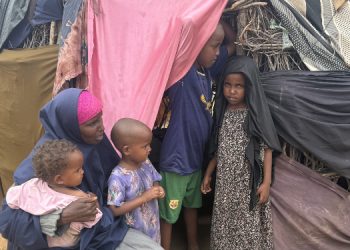
The girls were resting on a mat in their makeshift house in Beled-ul-Amin IDP camp in Deynile, Mogadishu, when Radio Ergo’s reporter visited.
Iisho had lost a lot of blood during the crude operation, carried out using local implements and without any pain killers. Iisho could barely speak to the reporter due to pain.
Her mother, Nurto Jelow, said that even though she herself suffered many problems due to the circumcision she underwent as a child, she believed having her daughters circumcised would protect the family’s reputation.
Nine girls were circumcised on the same day in this single camp outside Mogadishu, according to local sources in the camp.
Investigations show that there is an increasing prevalence of cases of Female Genital Mutilation (FGM) among the displaced people who have arrived in the city during 2016 and 2017.
Despite the high profile campaigns led by government, UN agencies and civil society groups aiming to eradicate the practice of FGM, mothers like Nurto are stubborn in their traditional beliefs and girls like Iisho have no protection.
Iisho and her sister have not received any medical attention since the operation. Warm water and salt is used to disinfect their wounds. Women in the camp believe that medication will slow down the girls’ recovery process.
“Warm water is enough for medication,” said Nurto.
She paid 15,000 Somali shillings, about $2, to the local women who conducted the crude surgery.
Nurto knows from her own experience that FGM affects women throughout their lives. She encountered excruciating pain during her monthly periods and during childbirth. But still she views FGM as the best protection for her daughters’ future.
Girls between the age of five and 10 are those at risk of being forced to undergo FGM. A local NGO, Somali Women’s Development Centre, has recorded 500 FGM cases in different IDP camps around the city in 2017. The real numbers would be far higher.
The Ministry of Women and Human Rights has proposed a bill to ban FGM but this has yet to be passed into law. Sadio Mohamed Nur, the head of ministry’s gender affairs department, told Radio Ergo she hoped parliament would pass the bill so that the perpetrators of cruel acts against girls can be punished.