

(ERGO) – More than 1,000 displaced families – evicted from a camp in Garowe, Puntland, where they had lived for up to 20 years – are struggling without livelihood opportunities or access to basic services on undeveloped land outside the city.
The families were given two weeks’ notice by the private landowners to leave Shabelle camp, on the outskirts of Garowe, in early July. They had lived there rent-free, whilst various services and facilities were established in the camp by aid agencies and the local authorities.
Shabelle camp, about one square kilometre in size, is one of nine camps known together as the Jowle IDP complex. There is concern that the other camps may also be emptied out as the city undergoes growth and development.
Many families from Shabelle moved with few belongings to a plot of open land about eight kilometres from the city. There are no services there and few job opportunities due to its distance from the urban centre.
Mutaad Ibrahim Hassan, a widow with 11 children, had been supporting her family on the $4 a day she earned doing odd laundry and rubbish-collection jobs in Shabelle camp. The eviction has cut her off from that work, as transport to Garowe costs about half a dollar.
She says she is now depending on food bought on credit from the few small traders who also relocated to the new settlement.
“The last time I cooked for my children was last night. It was already 11 at night when I could no longer bear their crying, so I borrowed half a kilo of beans. I don’t have a job anymore. The town where we used to work is now far away, and there is nowhere else for us to earn a living,” she told Radio Ergo.
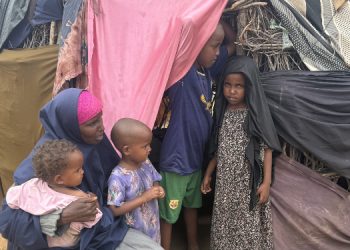
They brought the corrugated iron sheets and timber from their old shelter with them, but she has no money to rebuild it. She and her children sleep with neighbours, who managed to put up a house, and spend the day sheltering outside under trees.
“The landowners told us to leave because they needed their land back. We explained that we had nothing, but they didn’t listen to us. We are facing many difficulties here where we are now. We have no food, water or toilets. We have no means to cope,” Mutaad said.
The new settlement has no reliable water source. Mutaad borrows or begs a jerrycan from better-off families, as she can’t afford the 40 cents per jerrycan from private vendors.
Four of her children had been receiving free primary education at a school in Shabelle camp supported by Puntland’s Ministry of Education. There are no schools in the new place and she can’t afford to send them to fee-paying schools in Garowe. She fears the children, in grades two, three and five, will lose their education altogether.
She accumulated $25 in debt in just the past two weeks and fears the traders will refuse to give them more food on credit as the debt rises.
Only a few displaced families have managed to rebuild their shops or homes in the new area, usually with support from relatives. Most feel stranded without any opportunity.
Abdirahman Hassan Mudey, a father of 12, was a construction worker. He has been unable to work since the beginning of the year after falling ill and suffering paralysis in one arm and one leg.
In Shabelle camp, his wife earned around $3 a day from laundry work. Now they are depending on food she gets by asking better-off households for help.
“My 10 children depend on me, but as their father I am now disabled,” he said. “I was the one who worked for my children, but now I am sitting at home disabled.”
They left their makeshift shelter behind because they couldn’t afford transport for the materials. They are sharing a small shelter made from old plastic sheets and sticks that’s too small for the whole family.
Abdirahman said they miss access to the maternal and child health centre in Shabelle camp that was supported by Puntland’s health authorities. He can’t afford to pay for medical services in Garowe if anyone in the family becomes sick.
Seven of his children have had to drop out of school and Koranic classes: “They have nowhere to study and have become stuck at home. There is neither a Koranic school nor a regular school where we are. What will benefit them in the future is education. It is very important to me that they get an education, and I need help to make that possible.”
The chairman of the former Shabelle camp, Abdi Mallin Sabir, said the families were living now in extremely difficult conditions. The majority were children, women, elderly and people with disabilities.
“Some are living in shelters made from corrugated sheets that are open at the top. Others sleep in the open at night. There is no electricity and it’s dark. There are no health centres here. Previously, people could walk to work in the town because it was nearby. Now the town is far away, and it’s difficult for people to get there. Transport is limited, and what is available is expensive,” he said.
Abdi reported that a total of 1,042 families were displaced from the former camp. They have named the new settlement Shabelle as well, hoping for renewed recognition and support from aid groups and authorities. He said they had received no response yet to their appeals to the Garowe administration and humanitarian organisations.