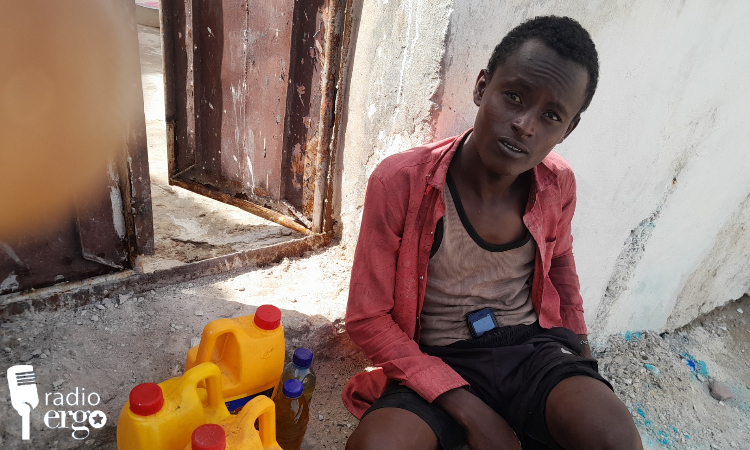
(ERGO) – Abukar Dayib Nuuh, 33, the eldest son in a family of eight, walks all day through the neighbourhoods of Marka carrying different sized containers of honey, going from door to door and visiting shops and community gathering places in search of customers.
He began selling honey in February after his father, the family’s main breadwinner, became bedridden with illness. Abukar took on responsibility for supporting his parents and siblings. Starting with a $150 loan, he now makes around $10 a day from his average daily sales of four litres of honey.
“This job has made it easier for me to carry a lot of burdens,” he said. “I have to pay the rent, I have to pay the bills, I have to buy my sick father’s medicine, and fees for my siblings who dropped out of school when my father couldn’t pay.”
In June, Abukar managed to enroll three of his younger siblings at Alnuur middle school, paying fees totalling $18 a month. He has also succeeded in returning to complete his own higher education.
“I was studying at university, but when my father became ill, the money for my education was no longer available and I stopped in my second semester. When the business improved, I returned to university. I thank God, this work has changed our lives,” he said.
Around 80 young people in this town in southern Somalia’s Lower Shabelle region are now making a decent living from honey sales. They come from poor families that have struggled to manage their basic needs due to adversity and diminishing livelihood opportunities.
Abukar buys honey from beekeepers around Marka, which he sells for $16 a litre giving him a $2.50 profit margin. He says he has big plans for the future:
“I would like to expand this business to other places, from Mogadishu to Barawe and from Galkayo to Garowe, and open branches. I dream of becoming a major trader! For now, I am a small trader, but I want to establish my own bee farm and become one of those producing honey. That is my ambition,” he said.
Another youth, Liban Hashim Nuune, 26, has been selling honey since April. He took responsibility for his family after his older brother disappeared on a migration journey overseas.
Liban’s honey sales allow his family of seven to eat three meals a day and enable him to pay the $25 school fees for five younger siblings
“My father died and my older brother who was supporting the family left the country,” he said. “Apart from God, I am the one the family depends on.”
Liban started with $100 borrowed from relatives and has since repaid the loan. He estimates that the business is now worth about $1,650, based on the value of his stock and savings.
His interest in honey grew after speaking with others already in the trade, who gave him tips and information. He sources honey from Siinay, about 18 kilometres outside Marka.
He is proud that his income has led to an improvement in his family’s living conditions, enabling them to move of a dilapidated one-room into a two-room rental house costing $30 a month.
Despite some customers being slow to repay when they buy honey on credit, he is glad to have ventured into the trade and hopes to establish a shop in town as a step up from selling door to door:
“I tell young people not to look down on small businesses. Small businesses can grow over time. Someone whose business is small today can become a successful trader tomorrow.”
The chairman of a committee representing honey traders in Marka, Mohamed Hussein Mohamed, said the livelihood was helping many low income families, although one of the main challenges was seasonal supply of honey. During the rainy season, honey from distant production areas becomes harder to transport to town.
“The white honey mainly comes from areas such as Tiyeglow and Baidoa. The red honey comes from Lower Shabelle and Hiran. Those areas are far away and the roads are difficult, especially during the rainy season, which creates challenges for us,” he explained.