

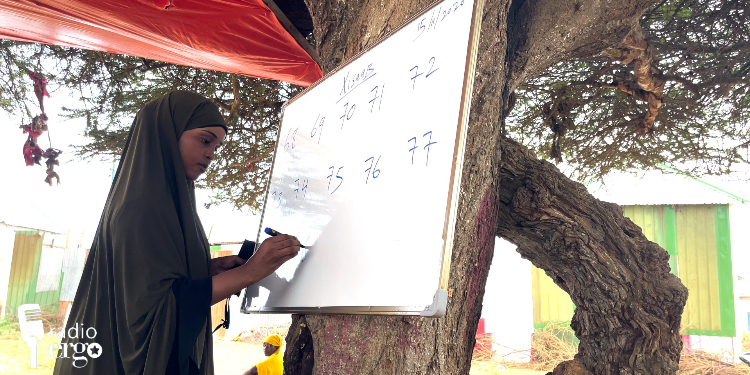
(ERGO) – The shade of a tree in Garasbaley on the outskirts of the Somali capital Mogadishu has become a classroom for 50 girls and women from displaced families, some of whom are receiving an education for the first time.
The students – aged between eight and 60 – are attending free classes at Fadumo Cureji Girls’ School, which was set up by a young female university graduate.
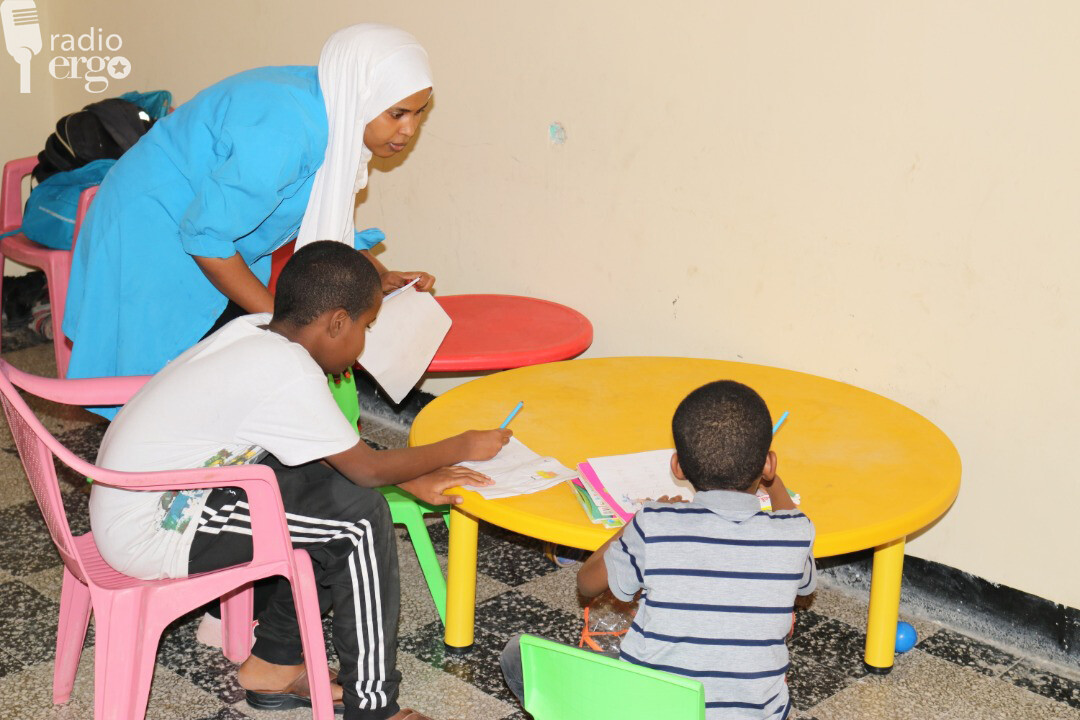
Without walls or desks, the school in Labaajo-boor neighbourhood serves women and girls from Nurshareco, Hawo Abdi and Weedow displacement camps. They learn reading, writing, mathematics and English, as well as practical income-generation skills.
Fartun Omar Abdi, 32, said poverty had prevented her from going to school as a child. She seized this chance to catch up.
“I could not go to school because of financial difficulties. I didn’t even have money to buy books and pens. I want to make the most of this opportunity,” she told Radio Ergo.
After one month, Fartun can write Somali letters and count to 100. She is learning henna art and hopes to use it to earn income.
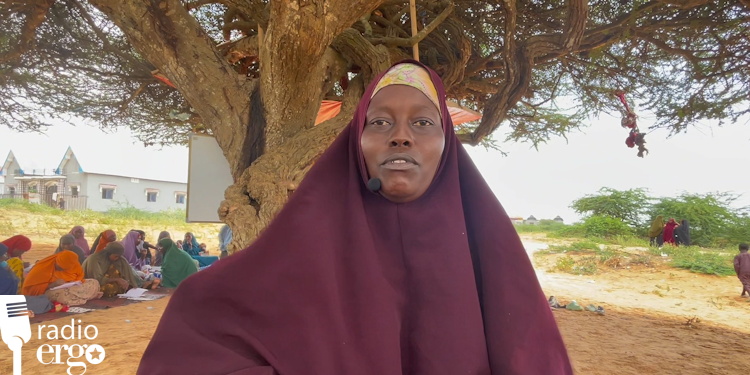
“Lizards and ants disturb us under the tree, and we can’t study peacefully because of the small children with us. But we are trying!” she said.
Fartun came to Garasbaley after fleeing clan conflict over land in a rural part of Bay region in 2017. She raises her seven children alone.
“I divide my day between looking after my children and finding ways to provide for them. For example, if someone asks me to wash their kitchen utensils, I earn $0.25. Sometimes, I also collect empty plastic water bottles and sell them in the market to get money for food,” she said.
The school was established by Nasra Abdinasir Dahir, 24, a university graduate in Mogadishu and now a health worker. She had wanted to become a teacher since childhood, but her family encouraged her to study health sciences.
The idea for the school came after she met a nine-year-old girl at the hospital where she works. The girl told Nasra how she badly wanted to learn but there was no school in her displacement camp. She asked the girl’s mother to bring her to the hospital for lessons.
Realising the extent of the need, especially among girls and women, she opened Fadumo Cureeji Girls’ School opened on 24 October.
“Imagine someone who has never seen a place of learning, who has never entered a classroom. Some of the girls had never even held a book. It took days to teach them how to hold a book and a pen properly,” Nasra said.
Six female teachers travel to the school every day for classes from 11am to 2pm. Rain sometimes stops learning and there is a shortage of books, pens and other materials.
Nasra said support would allow the school to provide formal education and practical skills to many more girls living in camps outside Mogadishu.
“I hope Fadumo Cureeji Girls’ School will eventually grow into a secondary school. I also hope it will have accommodation for girls who don’t have homes or those from other regions who want to go to school,” she said.
After hearing about registration for free lessons in the camp, displaced mother Sahra Hussein Hashi enrolled herself and her two daughters, Hawo Abdirahman, 10, and Halimo Abdirahman, eight.
Poverty had previously prevented her from sending her children to school.
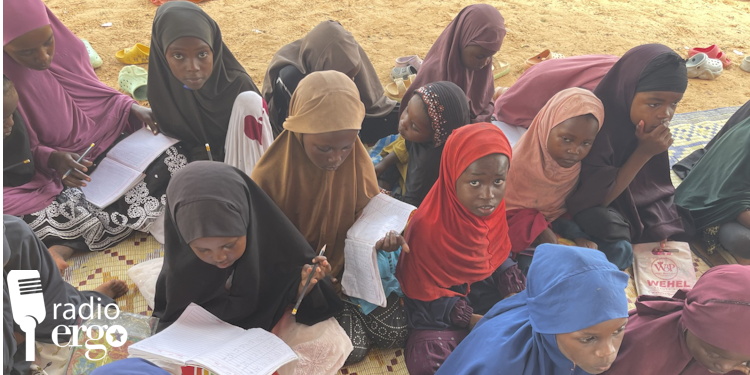
“Sometimes we do not even have enough for food and a place to sleep, so we couldn’t afford education. Now we have this opportunity to learn and a chance for a better future. Education has no age limit!” Sahra told Radio Ergo.
Neither she nor her daughters had held a pen or a book before. Now they are competing with one another in reading and writing. When they go into town, she encourages them to read the words on shops and signs along the roads.
Her four sons, however, are not in school and she worries that they are missing out. She joined the founder Nasra in wishing for support to expand the school, so that it could build proper classrooms and admit boys to study alongside the girls.