

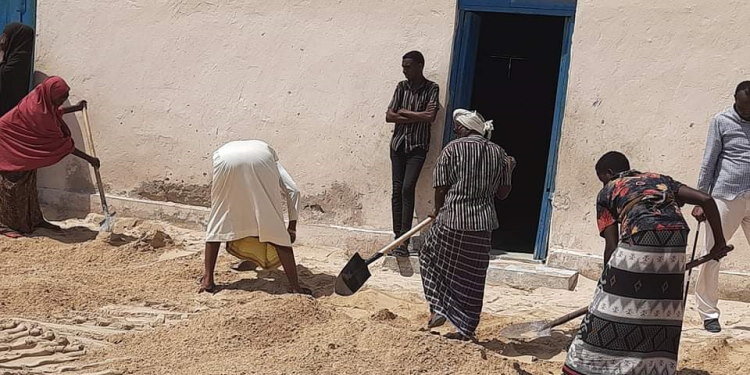
(ERGO) – Sand encroachment has forced dozens of families to flee their homes in a rural village in the south-eastern part of Galgadud, in central Somalia, leaving them without shelter and short of food.
The mostly pastoralist families living in Hul-caduur, near El Dher, were already struggling after more than a year of poor rainfall. The sand has further diminished their livelihoods, and has also buried the local health centre and the village’s only school
Abukar Mohamud Iidow, with a family of 10, said relatives in El Dher had sent them 20kg of flour, rice, sugar and cooking oil that they had rationed since the middle of September, and was nearly finished. They had received no other assistance and could not obtain food on credit.
“We cook only once every 24 hours. The sand has covered our village and displaced us. Our livestock have lost their value, and damaged roads have made food deliveries too expensive for us,” he said.
The sand buried Abukar’s three-room corrugated iron house while he was repairing it, along with the pen where his family stored water for domestic use and their livestock.
“No one died when the sand buried our home, but I suffered financial losses. I had spent $300, provided by relatives, on an underground water storage facility for my family and livestock,” he said.
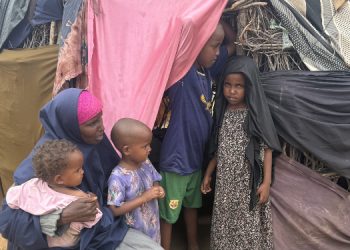
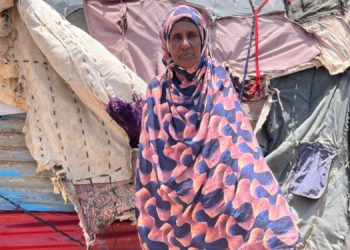
He and his family, with their youngest child of one, are squatting in a makeshift shelter of leaves and rags among trees outside the village. They fear they will have to move again if heavy rain starts.
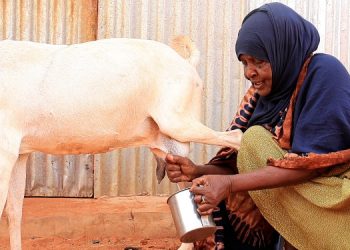
Abukar has 20 goats left, but they are too weak to sell and produce no milk. He said 55 died of his goats during the prolonged dry period due to lack of pasture.
His wife walks for more than an hour and a half each day to collect water from boreholes not yet covered by sand.
Three of his children went to the village’s only primary and intermediate school, which was closed after being damaged by sand and strong winds. One child was studying for free, while he paid $10 a month for each of the other two. The nearest alternative school is in El Dher, about 40km away, but he can’t afford to send them there.
He owes $800 for food, clothing and house-building materials.
“People I owe money to keep asking me to repay them. Sometimes they complain to my relatives. I tell them I will pay when I have something, but the debt sometimes keeps me awake at night,” he said.
Another resident, Abdullahi Mohamed Kulmiye, who supports a household of 13, said the sand had destroyed his small shop selling household goods and food. It was his family’s only source of income, earning him a daily profit of $8 to $10.
He rebuilt his five-room corrugated iron house twice and tried to protect the toilet and water storage tank from being buried by the sand, but eventually ran out of money and moved his family to the village outskirts.
“We tried everything to fight the sand, but when my money ran out, I gave up and brought my family here,” he said.
The family survived for two months on 35kg of flour, rice, oil, sugar and beans stored in the shop. The supplies ran out in mid-September, and they have since relied on food bought on credit from shops in El Dher.
Abdullahi has been unable to find casual work anywhere around, and two of his children are now out of school.
“I can’t afford to send my children to another school. The sand buried the school they attended, forcing us to leave our village. This is a heavy burden for me,” he said.
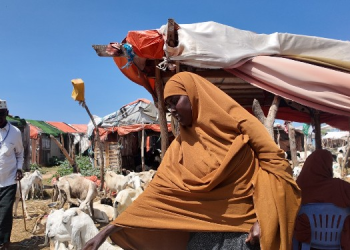
The sand has blocked two access roads so that vehicles use more fuel to make detours of about 25km. Transporting a sack of food from Galkayo or Mogadishu now costs traders $5, compared with $2.50 previously, pushing up prices in local shops.
Abdullahi, 50, said he had lived in Hul-caduur all his life and never experienced anything similar. He has no savings to help his family recover.
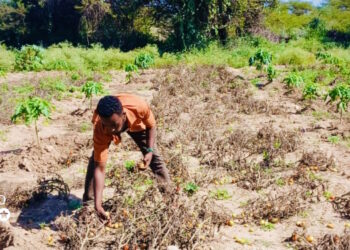
The village secretary, Yusuf Abdulle Hassan, said the sand was spreading rapidly across the southern part of Hul-caduur and surrounding areas, threatening to make the settlement uninhabitable. It has destroyed homes and essential services, as well as livestock, small businesses and farms.
“The sand dune hills around the village were already loose, and recurring poor rainfall has turned them into sand that spreads rapidly,” he said.
Yusuf said the most urgent problems were homelessness, lack of education and the destruction of the maternal and child health centre and market.
“Our community cannot afford to rebuild what has been destroyed. Our sources of income have disappeared, and we have nowhere else to work. We need help to control the sand and rebuild our facilities,” he said.
Yusuf said 130 families had been displaced and 213 pupils had lost access to education. He added that requests for assistance from the Galmudug government and humanitarian agencies had received no response.