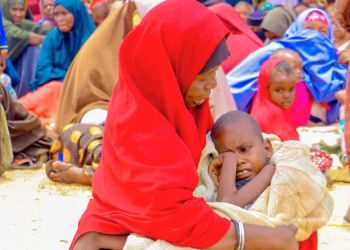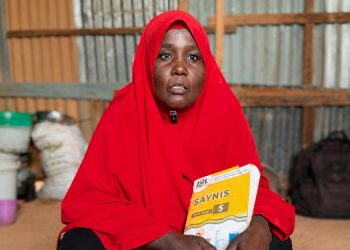


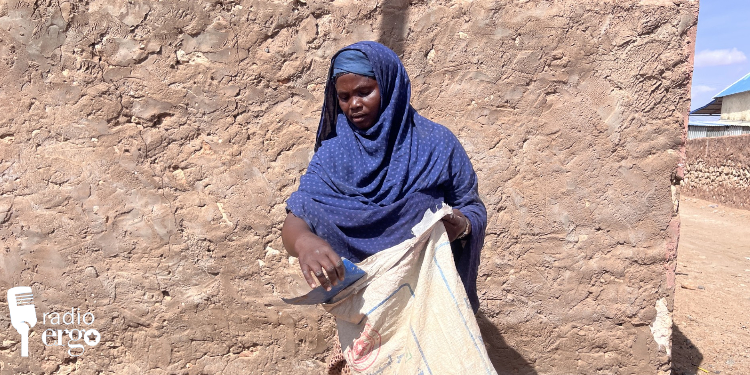
(ERGO) – Aqbal Adawa Haji has been struggling to feed her nine children and relied in the central Somali city of Dusamareb, as displacement left her without any source of income.
Now she’s collecting discarded metal from neighbourhoods across the town, earning $4 to $6 a day selling the scrap to local companies. It might not seem the best of jobs, but it enables her to feel dignified by supporting her children with their basic needs.
“Now I am a woman who earns money to buy rice for my children. I used to beg people for help, knocking on doors and hoping someone would give me something. Sometimes they did, sometimes they didn’t. Now I can manage my life. I buy what I need from the shops and my children are living better,” Aqbal told Radio Ergo.
The work is physically demanding, walking from morning until late afternoon through residential areas carrying heavy sacks of metal collected from households, rubbish sites, and open spaces. But she is thankful that her children no longer go to bed hungry. Four of them have recently enrolled in primary and Koranic schools, with Aqbal paying around $25 a month in fees.
“One of my biggest dreams was to see my children in school,” she said. “This month I finally enrolled them. Previously, none of them could study because I had no income and we were struggling. Now I feel happy because they are learning and I can support them,” she said.
Aqbal and her family fled conflict in Ethiopia’s Somali Region and settled in Oog displacement camp in Dhusamareb in September 2025. This is the first reliable source of income she has found since arriving.
She can pay for water and save money for emergencies and has already put aside $70 for when times might get tough again.
Around seven companies operating in Dhusamareb buy scrap metal from collectors for 15 to 20 cents per kilogram. The metal is transported to Mogadishu and Ethiopia for recycling and reuse in manufacturing.
Another scrap collector, Tima’ade Abdi Kabooy, has been earning enough to support his wife and 13 children since February.
“When a child needs something, I now have a way to provide it. PI had been at home without any work. Now I leave every day knowing I have something to do and a way to support my family,” he said.
Tima’ade earns about $160 a month, walking daily from Shabelle displacement camp, about 15 minutes from Dusamareb town, searching for scrap. Sometimes he gets injured by sharp objects and sometimes hostility from people who misunderstand what he is doing.
“You have to search through fences, bushes, and rubbish. There is nothing just lying around waiting to be picked up. My hands are covered in cuts from thorns and sharp metal. Some people insult you or chase you away, while others help by giving you scrap from their homes,” he said.
He sendspart of his income to support three of his children staying with relatives in rural Mudug region. He plans to enroll four more children in school for the first time.
Tima’ade’s family moved to Shabelle camp six months ago after drought wiped out their livestock herd in Mudug.
The manager of Bir-Libah Company, Abdullahi Ahmed Barale, said the firm had opened three collection centres in Dusamareb and Guriel employing around 20 young people. Around 150 people like Tima’ade and Aqbal are involved in collecting the scrap.
“We don’t collect the metal ourselves. We sit here and buy it from people. In that way, we have created employment opportunities. The scrap had no value before and was only causing environmental problems. Now poor families earn money from it while the town becomes cleaner,” he said.