

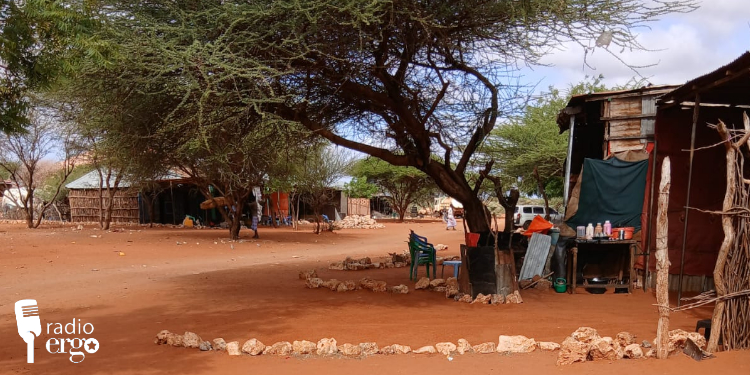
(ERGO) – When pastoralists in Qaranracade village, in Ethiopia’s Somali Region, migrated with their livestock hundreds of kilometres away in pursuit of the rains that had fallen in other areas, Fatuma Hassan Ige’s café closed.
Her business depended almost entirely on pastoralists buying meals and tea every day. The closure of her café cut off the only source of income for her family of eight. She had been making 2,000 to 3,000 Ethiopian birr ($10-18) a day that was enough to support the household.
“My business used to pay for everything – my children’s food, clothes, Koranic school fees, and all our household needs,” she told Radio Ergo. “Now life is very difficult. Sometimes we cook and sometimes we go without food. My customers were pastoralists, and once they left there was nobody left to cook for except my own children with whatever little food remained.”
The departure of the pastoralists also ended the supply of livestock and milk that sustained the village economy. As cash circulation declined, buying and selling almost stopped.
Fatuma said five of her children had been unable to continue attending Koranic school because she owes about $25 in unpaid fees for two months. She is under pressure from local wholesalers after failing to repay debts accumulated while stocking her café before it closed.
“I borrowed goods on credit and always repaid them before taking more stock. But when the pastoralists left, those who owed me money disappeared as well. I am owed around $200 by customers who left with their livestock, while I owe suppliers about $400. I don’t even know where to find the people who owe me,” she said.
Her husband can’t find work locally. He normally travels seasonally to Galkayo and Warder to earn money doing manual labour, but there are few opportunities now.
A barrel of water costs about $5 after being trucked nearly 30 kilometres from the nearest water source. Fatuma borrows 20-litre jerrycans from neighbours whenever possible as she has no cash.
Small businesses across Qaranracade are facing similar hardships. Abdirahman Hassan Abdulle, who supports a family of 10, closed his restaurant two months ago after losing nearly all his customers.
He used to slaughter up to two goats a day, making around $40 daily selling cooked meat and meals.
“The restaurant has been closed for the past two months. My family depended entirely on it and we could eat three meals a day. Now if we manage one meal, we are grateful. Sometimes we cook supper and save part of it for breakfast because there is nothing else,” he said.
Abdirahman owes about $700 to suppliers. He himself is owed $300 by his pastoralist customers who left the area before settling their debts. His family is also running out of water after buying a truckload for $100 on credit a month ago.
He hopes when the pastoralists come back his business could reopen, but he doesn’t know how long that could take.
“My restaurant served this community for more than 10 years, but I’ve never seen drought affect us like this. The pastoralists moved nearly 200 kilometres away. They used to bring livestock and milk and buy food from us. Once they left, the whole local economy stopped,” he told Radio Ergo.
Abdirahman himself was once a pastoralist before losing 160 goats and five camels during the severe Sima drought around 2011. He moved to the village in 2016 hoping to build a more secure livelihood through trade.
Community elder Abdiwahid Mahamud Aw-Khalaf said the prolonged drought had weakened the entire local economy by driving away the pastoralist families who sustained businesses in the settlement.
Around 300 permanent households live in Qaranracade, but more than 1,000 pastoralist families lived around the village, bringing milk, livestock, and other products to market while purchasing food and household goods from local traders.
He said about two-thirds of the village’s businesses had closed.
“The whole economy here depends on pastoralist families. When they stop bringing milk and livestock and stop buying from local shops, the market collapses. Businesses close, jobs disappear, and eventually even permanent residents begin leaving because they can no longer survive here.,” he said.
Across Ethiopia’s Doolo Zone, prolonged drought has forced many pastoralist families to migrate in search of water and pasture, leaving others in the intertwined social economy bereft of income and other resources.