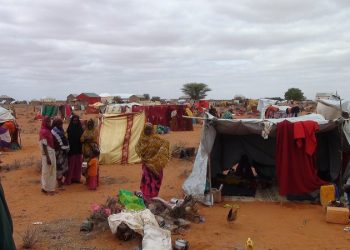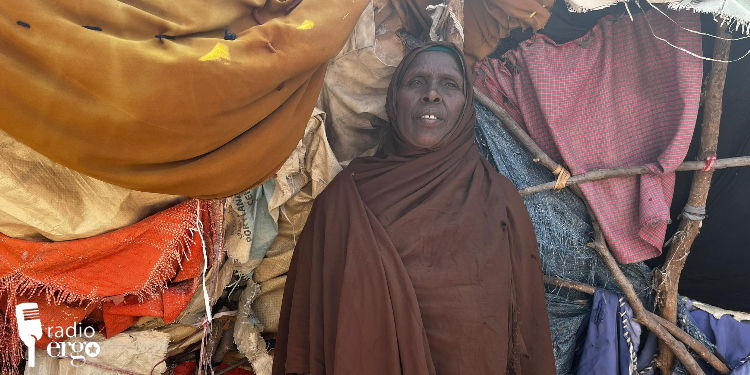
(ERGO) – Dozens of low-income families, who can no longer afford to pay house rent in the Somaliland capital, Hargeisa, have moved to Nasa-hablod displacement camp on the outskirts of the city, where conditions are poor.
Newly arrived families in the camp say they have lost their sources of income and been priced out of urban life.
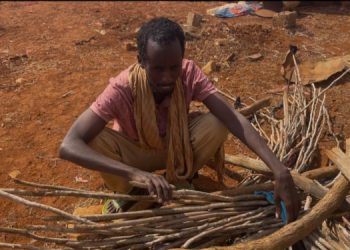
Sahra Ali Abokor moved to the camp after failing to keep up with $30 monthly rent, along with the cost of food and her children’s education. Their makeshift shelter made of old cloth and tree branches represents a significant downgrade in their living conditions.
“We are in a very bad situation. There is suffering and hardship. We have no proper shelter, no sanitation, and health problems are increasing. At night we use containers as toilets and empty them in the morning. This place is not fit for living,” she told Radio Ergo.
Sahra is raising eight children on her own after her husband died. Until late last year, she worked as a cleaner for a family in Hargeisa, earning $100 a month that covered their basic needs. But after losing her job in November, she was no longer able to support her household.
She has searched for casual work but has not found any. Former employers told her they could no longer afford to hire help, while other opportunities are now scarce.
Her family depends on cooked meals occasionally shared by neighbours and small amounts of money, as little as a dollar, sent by relatives. They rely on borrowing a single jerrycan of water per day from nearby households.
“Sometimes we don’t cook at all. We don’t have enough water. Life here is very hard, and we have nothing to depend on. We have nowhere else to go in Hargeisa, so we came here,” she added.
The land they have pitched their shelter on is privately owned, and the threat of eviction is another pressure. Living with high blood pressure, Sahra cannot afford regular medication and relies on relatives to buy it on credit.
Her eldest son has mental health issues and is being held at a treatment centre due to an unpaid bill of $250.
“They are asking me every day to pay the money. I don’t have it. If I try to take him out, they won’t allow it until I clear the debt. He is asking me to take him home, but where can I take him?” she said.
Four of her children have dropped out of Koranic school after she failed to pay two months of fees totalling $16.
Other families in the camp share similar experiences. Shamis Adan Daud, a mother of six, said her family has faced hunger, water shortage, and lack of shelter since moving to the camp in January.
“There is nothing I can rely on. We have no income, no assets, and no support. Sometimes we leave the camp and go to nearby neighbourhoods hoping someone will help us. Otherwise, we have nothing,” she said.
Shamis was evicted from her rented home on 31 December after failing to pay her $50 rent for six months. She used to rely on cleaning jobs, but those opportunities disappeared in recent months, forcing her into displacement.
Furthermore, the livestock owned by her family in the rural areas were lost to drought and disease, removing their safety net.
She also cares for a daughter with a mental health condition, but cannot afford treatment.
“I used to take her to a doctor in Hargeisa and she improved with treatment. Now I cannot afford it. She sometimes becomes aggressive, and I cannot manage the situation. I need help,” she said.
Four of her children are out of school, as there are no educational facilities in the camp and she cannot afford transport or school fees in the city.
For years, Shamis supported her family through a small business in Wahen market, which was destroyed in a fire in 2022. Since that disaster, she has been unable to rebuild her livelihood.
Female camp leader, Yurub Abdullahi Jama, confirmed that the newly displaced families were facing extremely difficult conditions. She said they received 42 families since December who had been evicted from rental houses as they couldn’t meet their obligations.
“These people had no choice but to come here. They are facing severe hardship, and there are no services available. There are elderly people, people with disabilities, and others who cannot work. The needs are overwhelming,” she said.
Yurub added that the camp lacked schools and health facilities.
The nearest hospital is about seven kilometres away in Hargeisa. Transport costs are beyond most families’ means, leaving many suffering without access to treatment.