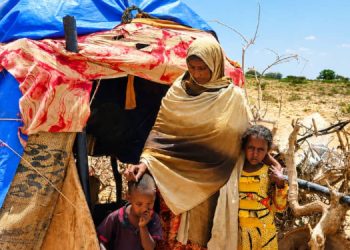


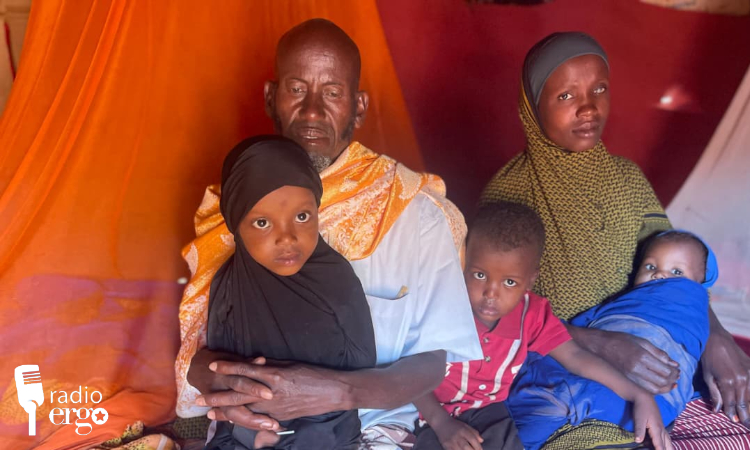
(ERGO) – Thousands of families uprooted by the recent conflict in southern Somalia’s Bay region, including many who were already displaced, have fled into drought-hit rural areas, where they can’t access adequate food, clean water, and shelter.
Gudey Abdullahi Malin, a mother of eight, told Radio Ergo that she fled her home in Baidoa with her children after violence erupted in her area in late March.
She is now living in Buula Gedisoy village, about 20 kilometres away, where conditions are tough and the local community has little to share with others.
“We have nowhere proper to sleep. At night we stay out in the open, and during the day we sit under trees. We don’t have shelter to protect us from the heat or cold. What we need most now is food and water for the children,” she said.
Gudey said her children had gone for a long period without any food, and had begun vomiting after eating again. Some of the children have become sick from drinking unclean water.
A jerrycan of water costs around 5,000 Somali shillings, which she cannot afford, so she has been begging small amounts of water from others, although the water is not always clean.
“Sometimes the children get only one meal a day from people here. Other nights we sleep hungry. They are not used to this environment, and many are sick,” she added.
Gudey and her husband had been making a modest living collecting and selling firewood, earning $5 – 6 a day that income enabled them to meet their family’s basic needs.
She said the conflict had caused them to experience displacement for the first time in over two decades, describing the current situation as overwhelming.
Two of her children were in school and had their studies disrupted by the sudden move.
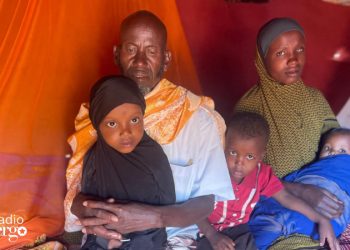
The situation is similar for Abdullahi Abdi Mohamed, a father of eight, who fled Baidoa to the same village, where he says conditions are poor.
“We depend on what people here can share with us. Sometimes they give us a small meal at night, but other times we have nothing. Today I gave my children dry food that was borrowed from someone. There is nothing stable in our lives right now,” he said.
Abdullahi described the journey to safety as extremely difficult. Unable to afford transport, his family walked for a full day and night. The cost of hiring a vehicle had risen to about $100 due to the sudden spike in demand as conflict reigned.
He had been relying on casual construction work in Baidoa, earning around $5 a day. In the rural village where they are now, there are no such opportunities. The prolonged drought has left local residents’ incomes depleted and unable to provide much support.
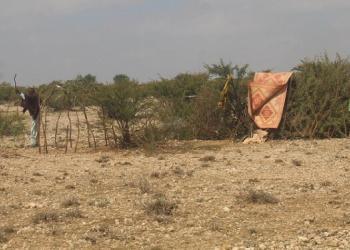
“We came here because of the fighting, but life here is even harder. There is drought, no work, and no services. We are staying in makeshift shelters that don’t protect us from the weather,” he said.
Local community members say many of the displaced families were already living in poverty before the conflict, surviving on daily labour in Baidoa. Their displacement has cut off those income sources, pushing them into deeper vulnerability.
Mohamed Abukar Ali, a youth activist involved in relief efforts, said many families were now scattered across villages around Baidoa and other towns such as Dinsoor, where there were severe shortages of food and water.
“These families were already struggling, and now they have lost even the little they had. The areas they have moved to lack basic services, making their situation extremely difficult,” he said.
Mohamed added that local initiatives were being made in response to the crisis, including water trucking supported by community members, businessmen, and diaspora groups. Around 40 truckloads of water had been delivered to affected areas.
“People came together to help as much as they could, but the needs are far greater than what local efforts can cover. More support is urgently needed,” he said.
The UN’s refugee and displacement agency UNHCR reported that about 50,000 people had been displaced by the recent fighting in South West region. Many are now facing a combination of conflict-related displacement and prolonged drought, which has eroded livelihoods and left them with limited access to essential resources.