

(ERGO) – In El-aqwan village in Somalia’s central Mudug region, pastoralist families whose livestock have died are experiencing rewards after turning to small-scale farming.
Abdullahi Ahmed Dirie is now cultivating vegetables. His 2.5-hectare plot is producing tomatoes, onions, watermelon, and leafy greens that used to be unfamiliar food items in his family’s daily diet.
His shift to farming began a year ago, under a programme by the Norwegian Refugee Council (NRC), supported by the UN’s World Food Programme (WFP) and the Galmudug state government that targeted families who had lost livestock and lacked alternative skills or income.
“This farm is now the most important thing in my life. Everything my household needs is produced here,” Abdullahi sad. “When crops ripen, we harvest what we need to eat, and sell the rest. Food, clothing, and even livestock feed now comes from this land.”
He planted his first crops in August and since then has earned about $775 that meets their basic needs.
He harvests at least six jerrycans of vegetables every day, selling them to traders from Galkayo and nearby areas at prices lower than those offered by large wholesalers. Demand for his produce has steadily increased.
The income has helped him to pay off $270 of his debts of $870 accumulated of a year without any income. He had relied on credit from local shops and occasional help from relatives, after jobs breaking stones earning $5 to $7 a day ended in mid-2023 when larger suppliers displaced casual labourers.
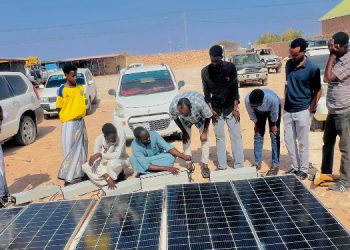
A three-month practical training course covering land preparation, crop selection, pest control, and water management was provided for 80 pastoralists. Abdullahi says the training gave him confidence.
Farmland was allocated and prepared, and irrigation pipelines were installed from nearby boreholes. Abdullahi says the availability of water changed everything.
“In the past, we were always searching for food, travelling to Galkayo, begging relatives, or borrowing,” he said. “Now everything has changed. We no longer beg for vegetables or buy them on credit. People trust us because they see our produce.”
By November, many were harvesting and selling produce and planting again.
Abdullahi has also planted fodder grass alongside his crops to support his remaining livestock. He keeps 10 goats, three of which produce milk for his children again.
His family was displaced in 2023 from Qorasayn village in Mudug when the drought killed 63 goats and five camels, leaving them with just six weak animals.
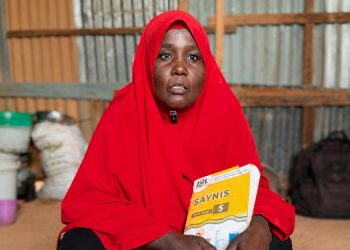
Similar progress is reported by Bashir Ahmed Mohamed, another farming convert, who says his family is no longer facing hunger. He earned $580 from his harvests to cover household expenses, rent, and reinvestment in further farm production.
“We planted vegetables and achieved good results. Before, we barely knew vegetables or ate them. Now my children are healthier and stronger. Our lives have improved by at least 70 to 80 percent,” he said.
Bashir cleared $140 in rent arrears for the two corrugated iron rooms housing his family of seven. He plans to enroll two of his children in primary school for the first time.
He credits the training with equipping him with practical skills and infrastructural investment with making the farms successful.
“They extended the borehole, built water tanks, fenced the farms, and prepared the soil for us. We received seeds and tools. That support helped me clear old debts and save something for the future,” he said.
Bashir established his farm on land owned by his father, avoiding rental costs. His family arrived in El-aqwan in 2022 after drought wiped out nearly all their 300 goats. Attempts to earn income through construction work in Galkayo proved hard due to limited opportunities.
The chairperson of the El-aqwan farmers’ association, Abdirahman Said Farah, said:
“These farmers were selected based on vulnerability. Many had lost livestock and had no way to earn a living. The training, tools, and inputs helped them turn farming into a reliable source of income.”
Training sessions included vegetable production, soil nutrition, pest management, and fencing to protect crops from animals and damage.
For pastoralist families in El-aqwan, the shift to farming has restored food and income and a sense of dignity and stability after years of loss.