(ERGO) – Families across southern Somalia’s Bay and neighbouring regions have exhausted their coping mechanisms after consecutive dry seasons, with thousands forced to abandon rural villages and move into displacement camps, especially near Baidoa.
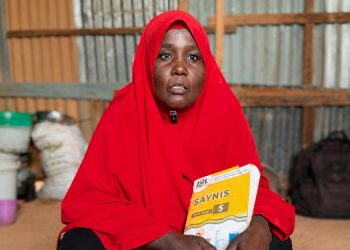
Ibrahim Daud Omar is now living in Gawaan displacement camp on the outskirts of Baidoa. He and his family of eight joined the camp in December after losing everything to drought.
“We are living in extremely harsh conditions since we arrived here. Sometimes the family gets food once, given out of compassion by Muslims who see our situation or relatives we call. There is nothing else coming in. No organisation has helped us, and there is no life here. I need food for my children, but I cannot get it,” Ibrahim stated.
Their last remaining food stocks of sorghum and beans ran out months ago. Ibrahim, 60, says he has little hope of changing his family’s situation as he can’t find labour jobs. His wife is ill and his children are too young to earn income.
Gawaan camp lacks a borehole, forcing families to rely on water brought from private wells four kilometres away. For Ibrahim, even this option is out of reach as he can’t pay 5,000 Somali shillings for 20 litres of water. They survive on three to five litres begged daily from neighbours.
“The pressures on us are hunger and thirst. We have no water to use. Life is water and food, and we have neither. There is nothing for children to drink, nothing to cook with, nothing to wash with. We are suffering greatly.”
Ibrahim says they were displaced from Oflow village in Dinsor district at the beginning of December, after the last one of their 30 remaining goats died.
Income from farming, once the backbone of his livelihood, had also shrivelled with the drought. In September, he planted grains and vegetables on his four-hectare farm, but the crops all failed due to lack of rain.
He has debts of $200 that he used to buy seeds, labour, and for land preparation. Displacement has also exposed his children to harsh living conditions:
“When we lived in our village, we had a proper house. Now we sleep outside because we have no shelter. At night, the cold becomes severe. We huddle together. During the day, there is nowhere to escape the heat.”
The family walked for two weeks to reach Baidoa after failing to find transport. Ibrahim is worried about three children suffering from high fever, but the camp has no health facility and he can’t afford to seek private medical care.
Farhiyo Mohamed Mahmoud, who has been a farmer for two decades, was also displaced for the first time last October. She and her 10 children are now living in a makeshift shelter made of cloth and sticks in a camp near Baidoa.
She walks daily into nearby bushland to collect firewood to sell in town, hoping to earn enough for a single meal. She makes at most $1.5 a day that hardly gets her anywhere.
“Life has become extremely tight. Our farms failed due to drought, and we came to Baidoa searching for survival. Hunger grips us day and night. Children go hungry for 12 hours. The situation is very bad,” she told Radio Ergo’s local reporter.
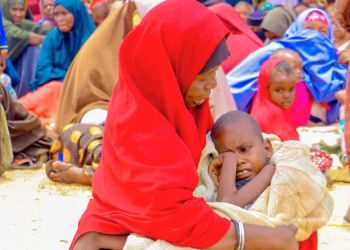
Farhiyo has an eight-month-old baby for whom she can’t buy milk. She says the baby cries through the night from hunger.
She fled alone after leaving her husband behind in Abay-dhiin, about 60 kilometres away, to look after their seven cows that could not travel the long distance with them. She arrived with nothing, abandoning her home and belongings.
Debt weighs heavily on her as well: “I owe around four million Somali shillings borrowed for farming. The crops failed, and I could not repay anything. Life and debt are crushing me.”
The director of the South West State’s Humanitarian Affairs and Disaster Management ministry, Hussein Noor Aden, said the drought has devastated the region’s main livelihood systems and left more than 621,000 people across the state in perilous living conditions:
“The immediate problems people face are hunger, water shortage, lack of rainfall, malnutrition, and loss of crops. Out of the 18 districts in South West State, 10 are the worst affected.”
He said limited water trucking and food distribution had begun, but funding constraints and growing displacement mean assistance falls far short of needs.
Somalia’s disaster management agency, SODM, also warned that failed Deyr rains and poor Gu seasons have left much of the country facing severe humanitarian conditions.
As families continue to arrive in camps around Baidoa, food, water, shelter, and health services are urgently needed to prevent the situation from deteriorating further.