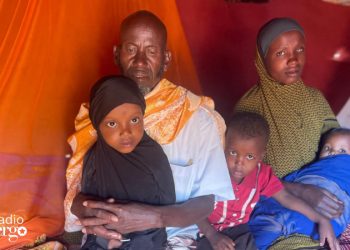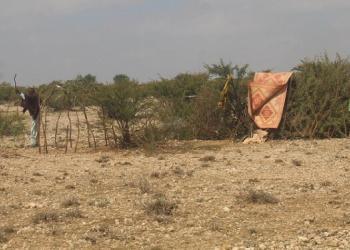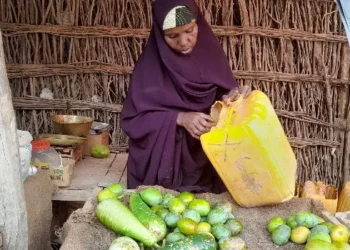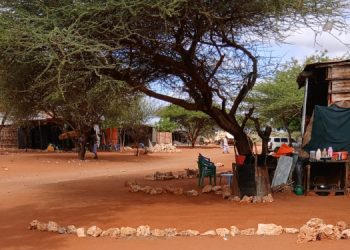


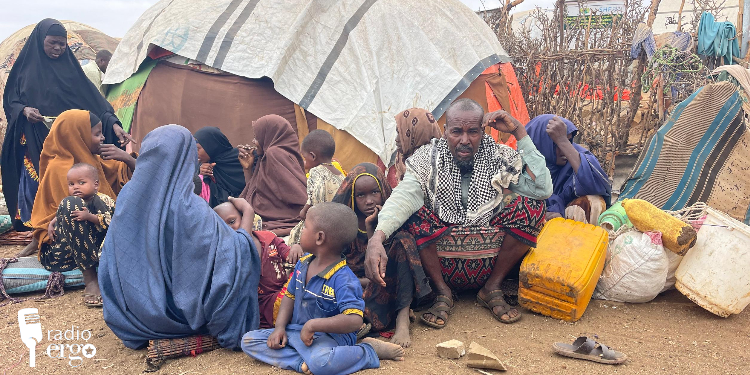
(ERGO) – Hundreds of farming and pastoralist families have been forced to move into displaced to camps around Baidoa since December, as drought destroyed their crops and killed their livestock.
Bisharo Ali Yarow, in Rama-adey camp, says her family of nine is living in extremely difficult conditions, often spending the entire day begging in Baidoa town, about two kilometres away.
“We have nothing at all. Whatever we find is cooked once for the children. Each person gets just a spoonful of food, which is not enough,” she said.
“I used to cook for my children three times a day. We sold milk and livestock. We were people who had something.”
She failed to find casual work in Baidoa, partly because she is new to the city and knows no one. Her husband is elderly and unable to contribute to the household.
The family relies on a single jerrycan shared among households, borrowed from others who arrived in the camp earlier. Bisharo says she can’t afford the 5,000 Somali shillings charged for water from nearby private boreholes.
This is the first time Bisharo’s family has been displaced in 24 years of living as farmers and pastoralists in Oflow village, near Baidoa.
Drought destroyed both their livestock and crops, leaving them with no option but to flee to live in a shack.
“We lost what our animals depended on. Even our donkeys died of hunger. Our farms also failed. That is why we were displaced. We have not found any improvement yet. The same hardship continues,” she complained.
Four of her children dropped out of Koranic school as she couldn’t pay the $8 per month fees. There are no schools in the camp and she can’t pay $5 per child charged by schools in Baidoa town.
Bisharo says she is repeatedly asked to repay the $150 she borrowed while in her village to buy food and farm inputs.
The family lost 36 goats and cows after two consecutive poor rainy seasons. They had a three-hectare farm that used to support them. Bisharo says she invested $270 in seeds, ploughing, and irrigation during the last planting season, but the harvest was wiped out.
In Doolow 1 camp, Hussein Ibrahim Adan can barely secure a single meal for his large family of four wives and 16 children.
“Our children are bitten by mosquitoes. Their bodies are swollen. We don’t have mosquito nets. We sleep on the ground, and insects crawl over us at night. They don’t get proper food. We live on what we beg for. If nothing is found, we sleep hungry. We ask God for help,” he said.
He said most of the children have fever and as there is no health facility he can’t get medicines.
Being displaced has left him deeply discouraged, as he can’t find any casual labour to support the family. He owes $130 borrowed to cultivate his four-hectare farm, although the harvest failed in October.
“The crops failed, and I have nothing to repay the debt. The people keep asking me for it, and it worries me greatly because I have nothing to give them,” he said.
His tomatoes, onions, maize, beans, and sorghum were destroyed by pests and lack of water. The family also lost 37 goats due to lack of pasture and water.
Hussein says the family walked for two days and nights from Buula-nuur village, about 60 kilometres away, arriving in the camp with nothing. They were unable to transport their traditional shelter or household belongings.
The chairman of Rama-adey camp, Abdikadir Malin Abdinuur, said the newly arrived families were in extremely poor condition and relying on those who arrived earlier, despite their own limited resources.
“They have no water, no food, no shelter, no bedding, and no household utensils. You see five families sharing one cooking pot. They also lack health care and education. They face many problems,” he said.
The camp chairman said nearly 400 families displaced by drought had been registered in December, mostly from rural areas around Baidoa.