

(ERGO) – It’s estimated about 100 men selling gas for cooling appliances along Mogadishu’s streets have been put out of work due to the takeover of the market by large companies and stricter safety demands.
Radio Ergo found 10 of these men who had been forced to move with their families into displacement camps on the outskirts of the city, as they could no longer afford rent in the city.
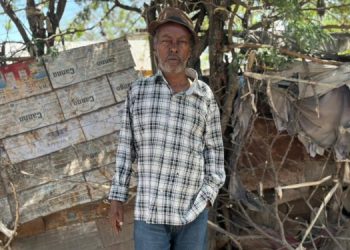
Abduqadir Ali Hussein says the collapse of his business refilling gas cylinders for cars, refrigerators, and air conditioners, has left his family struggling for basic necessities.
“Right now, we have no way to survive. If we eat dinner, we skip breakfast. I can’t even get 1,000 shillings. In the past, our relatives would come to help, but now no one has anything to give us,” he told Radio Ergo.
For six years, Abduqadir refilled gas cylinders on the roadside providing the only source of income for his family. He walked the streets daily finding customers.
However, customers these days demand official permits and safety guarantees before buying gas. Big companies have moved in to take over the business.
Abduqadir’s family of eight moved to a displacement camp as he couldn’t pay $20 rent for their house in Dharkeynley district. His children sleep in a flimsy makeshift shelter made from plastic sheets.
“We’re now like displaced people. We built a small hut from plastic sheets we were given. We used to rent a small house in Medina, but I was evicted three months ago. I had no choice but to move here,” he said.
Abduqadir says small gas cylinders were connected with pipes to refill vehicles and appliances on the streets. The modest income he made was reliable. He had left Somalia as civil strife began in 1990, spending 25 years in Yemen. But he had no skills so turned to street trade.
New companies selling gas hold government licenses and provide safer services, earning customers’ trust and pushing informal vendors out of the market.
“In the past, customers called us regularly. Now, sometimes only one car appears all day, and we fight over it. Before, I served up to eight cars a day, earning $25 to $30. Gas was cheap then. Life was far better for us,” he said.
The collapse of his street trade affected his children’s education. Two were in fourth and sixth grades, and three attended Koranic classes, all costing $35 a month.
Mustaf Duale Dayib, another street gas vendor, has also lost out.
“I can’t pay rent, school fees, or even water and electricity bills. Food is scarce; some days we eat, some days we don’t. When we do, we just thank God. That’s how we survive,” he said.
Mustaf and his 14 family members moved to Badbaado displacement camp in July after failing to pay $70 for their five-room iron-sheet house.
His wife has to walk two kilometres to a privately owned well to get clean water, paying 6,000 shillings for 40 litres.
The camp lacks basic services, including healthcare, education, and sufficient water. Six of Mustaf’s children, who previously attended school and Koran lesson, are now out of school. He also owes $400 for food and water purchased during the toughest of months without income.
“All the places where we worked are gone. New centres have opened, run by richer people,” he said. “Our income has completely disappeared, and we live in constant anxiety,” Mustaf said.
He also claims that gas is being used for substance abuse, helping to push up the prices.
Another seller, Abdisalan Mohamed Beyle, the sole provider for his elderly mother and five younger siblings, says he has been unable to cover the family’s basic needs since June.
“Gas prices are too high, and customers don’t come anymore. Before, I earned $20 to $25 a day. Now, I get one or two dollars, if I’m lucky,” he said.
His relatives helped him pay $50 rent for his family’s place in Wadajir district, but he remains in arrears. Three of his younger siblings were sent home from school after two months of unpaid fees.
For decades, street trade has been a backbone for low-income families in Mogadishu, where there is limited formal employment. In recent years, however, many informal livelihoods have disappeared.
The shift to licensed companies, while improving safety for consumers, has displaced many street vendors who have no skills to depend on.