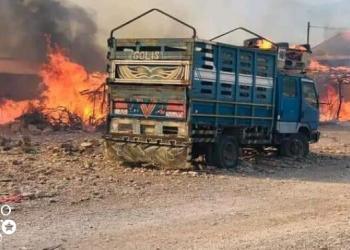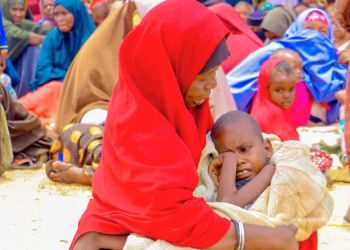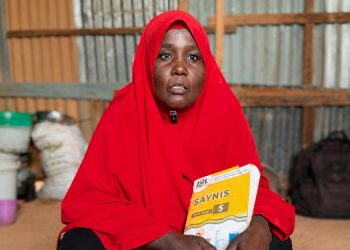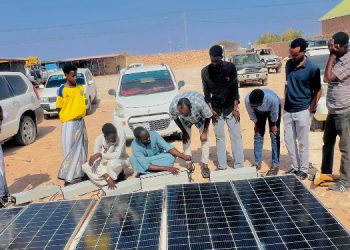


(ERGO) – Hundreds of farming families in Arabsiyo, Somaliland’s Gabiley region, are facing one of the worst economic shocks in years after a destructive wave of moths swept through their fields in September, wiping out crops due for harvest and others nearing maturity.
The outbreak has left households burdened with debts and unable to keep up with essential expenses such as school fees and reinvesting in their farms.
In Arabsiyo, nearly all families depend exclusively on agriculture, so the sudden collapse of the harvest season has had far-reaching consequences. The farmers’ association says 500 families are affected.
For farmers like Ismail Abdi Hasan, the losses came as he expected to recoup months of hard work.
Standing on what remains of his six-hectare plot, Ismail describes the devastation. Maize, tomatoes, onions, peppers, watermelons, and cabbage, all of which he had been preparing to harvest in October, were destroyed in a matter of weeks.
Ismail was left with a debt of $2,000 for his investment in seeds, irrigation, labour, and farm treatments. He says the situation has plunged him into confusion and despair.
“We are farming people. This farm is all we know, the pest threw us into deep frustration. It took away the livelihood we used to sustain our families. We don’t have any other work in town.”
With six children, Ismail survives on credit from local shops, but with unpaid debts he can’t borrow any more. His children’s education is on hold as he can’t raise the $250 due in November for four of them in university.
The farmers have no clear understanding of the pest consuming their crops. Local accounts suggest it originated in the Americas, passed through North Africa, and entered Somaliland from Ethiopia in imported tomatoes.
Farmers say it first appears like a leaf worm, laying thousands of eggs, before turning into a caterpillar-like creature that multiplies quickly in hot weather.
The Somaliland Ministry of Agricultural Development has confirmed that the outbreak is caused by tuta absoluta, a highly destructive Tomato Leafminer moth known for rapid spread and severe crop damage.
For Ismail, the combination of financial loss, uncertainty, and a still-present threat has made it impossible to replant.
“I cannot re-till the land, the pests are still here. There is also water scarcity. I don’t know how to revive the farm.”
Farmers in the area report that the moth dries out plants from the inside, feeding on the fruit and nutrient-rich leaves. It destroys fields in under a month. Efforts to control it using both chemicals and natural methods have failed.
Mukhtar Ibrahim Mahamud, another farmer hit by the outbreak, says the moths ruined vegetables on his four-hectare farm just two weeks before harvest. Since October, his family of five has been struggling to cope with the loss.
Mukhtar now relies entirely on borrowed money, and his debts have reached $500, with an additional $2,000 owed from investments he made in seeds, water, ploughing, and labour. He had aniticipated selling vegetables worth over $4,000 to markets in Arabsiyo and nearby villages.
“Everything was supposed to be harvested this month, but nothing came out. When financial pressure increases, you feel it deeply. Even as a Muslim who should remain patient, the loss of everything you worked for is painful.”
He is unable to pay $80 in monthly fees for his three children in school and Koranic classes.
The farmers highlight the long-standing challenge of water scarcity in Arabsiyo. The community relies on privately dug wells, ponds, and water delivered by tankers when necessary for dry-season farming.
Agricultural expert, Halimo Hasan Odowaa, from the Somaliland Ministry of Agricultural Development, recently inspected the affected farms and explained that the moth appears mostly at night, laying eggs inside young fruits, where the larvae grow and later feed on the plant’s leaves.
“The most important control method is to set traps made of small papers coated with glue. The moths stick to the glue and die. Improving irrigation also strengthens the plant’s resilience,” she told Radio Ergo.
While farmers welcomed the advice, they stressed that technical guidance is not enough. With extensive financial losses and depleted resources, they urgently need support to restart their farms, purchase inputs, and manage the continuing pest threat.
So far, the government has provided no material assistance, leaving families to absorb the impact alone.