(ERGO) – When repeated droughts decimated his herd and left him despairing, Somali pastoralist Elmi Abdi Hirow decided he would not watch his animals die in the open rangelands again.
Drawing on his experience and determination to find a lasting solution, he built a modern livestock enclosure that now safeguards his camels from hunger and disease, and keeps his children well fed.
On the outskirts of Beletweyne, Hiran region, Elmi’s fenced enclosure, set up in late 2023, has become a lifeline for his animals. Once thin and weak, his camels have recovered their health and productivity.
“I started this enclosure because of the frequent droughts. Pasture is scarce, the livestock were suffering and losing weight. I realised animals could be cared for if given a proper enclosure and fed on fodder, hay, maize, and other supplements. That stops them from dying of hunger or having to walk long distances without finding pasture. The lactating and weak camels are now sheltered and it has worked perfectly,” he told Radio Ergo.
Elmi is keeping 49 camels, mostly lactating females, that feed on hay and crop residues supplied by nearby farms. The enclosure, measuring 120 metres around, is equipped with water pipes connected to a borehole.
Each pastoralist who keeps animals there pays $10 a month for water. The costs of feed and water are covered by the sale of milk that Elmi takes to markets in Beletweyne.
“We sell milk every morning and evening, and it’s always in demand because it’s clean and fresh,” he said. “The milk pays for the feed and other needs. It’s a good system for anyone who understands camel keeping. The animals are healthy and productive, and we no longer have to wander in the sun looking for pasture. The camels thrive, and so do their owners.”
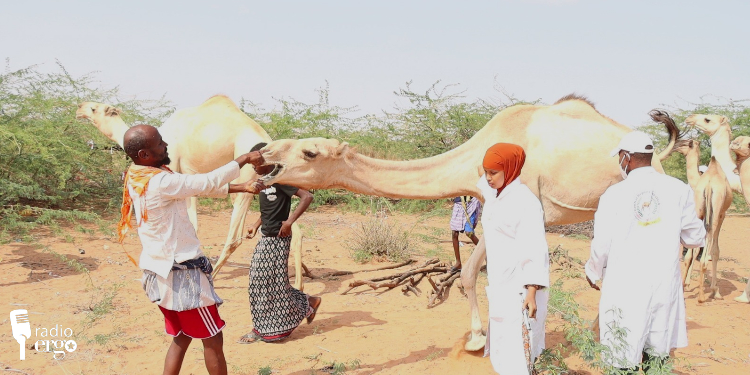
Elmi lost 30 of his camels to drought. Now, his animals receive veterinary care every two months from the Central Regions Livestock Care Association (CERELPA). The veterinarians conduct check-ups and provide treatment within the enclosure.
He earns about $150 a week from milk sales, spending part of that income on animal care and the rest to support his family of 11.
“I no longer worry about drought as I used to,” he said. “The camels are in good shape, and our lives are more stable.”
Half of the animals in Elmi’s enclosure belong to other pastoralists, who also lost most of their herds to drought.
Over the past two years, more than 30 similar livestock enclosures have been established around Beletweyne. Many pastoralists see this as the only practical way to save their herds from recurring droughts.
Before starting, they received training and guidance from livestock experts on how to protect and care for their animals in changing weather conditions. The initiative has since evolved into both a recovery strategy and an income source for drought-affected families.
Dr Ali Harare Mohamed, a veterinarian with CERELPA who has worked in animal care for over 40 years, said climate change has severely weakened the resilience of Somali livestock. He encourages pastoralists to adopt enclosures to protect their animals.
“This method ensures livestock survival, and when animals survive, the entire economy benefits. Around 75 to 85 per cent of our national income comes from livestock. If they perish, the economy collapses. These enclosures have helped animals recover, and everyone involved is benefiting,” he told Radio Ergo.
He added that camels raised in this manner produce more milk as they get better nutrition, which benefits pastoralists and also farmers supplying hay and fodder.
Hundreds of herders are now using this approach, although most pay monthly fees to house their weakened animals in communal facilities.
Among them is Mohamed Saney Aadan, who keeps 30 camels. He cannot afford his own enclosure, so he uses one of the communal sites near Beletweyne to rehabilitate his animals.
Radio Ergo’s local reporter met Mohamed as he was preparing to return 16 camels to the rangelands of Takaraalle, about 70 km from Beletweyne, after three months of care in an enclosure.
“I came to town to take back my camels, which have regained strength and health. With the ongoing rains, I want them to graze again in the rangelands. Here they’ve had access to fodder, water, and medicine. Now they’re ready to go back,” he said.
Mohamed did not spend any money on their care, as the milk from his lactating camels covered the cost of fodder, water, and enclosure fees.
The money he used to spend on the animals’ keep will now support his family of 16 children, who were relying on food bought on credit. He milks more than 15 containers of milk daily, earning over $10.
Mohamed said he no longer worries about losing his camels to drought as he plans to bring them back to the enclosure after the Deyr rains. He would like to build his own enclosure, but without the funds the current arrangement works.
However, he does worry about his 50 goats, as there is nowhere to keep them safe. Over the past four years, he has lost 70 animals, including goats and camels, and is now recovering, with some camels giving birth and others pregnant.
Dr Ali Harare says the modern livestock enclosures have created new links between pastoralists and farmers – the farmers sell crop residues and hay from their fields as animal feed, while herders get better milk production and earn more from milk sales.
“It’s a win-win for both sides,” he told Radio Ergo.