

Hundreds of families displaced by conflict between government forces and Al-Shabaab in Barire, southern Somalia’s Lower Shabelle region, are living in an open field on the outskirts of Afgoye, facing desperate conditions.
The conflict destroyed their homes, farms, and small businesses, and since arriving in Afgoye with nothing they have not received any aid.
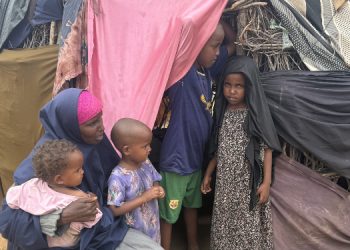
Farhiya Mohamed Ali has been begging for food from locals for her family of nine since 29 July. She said she sometimes was given a cooked meal or a small amount of money that allowed her to buy food for a basic meal.
“My family’s life is difficult and my children are suffering,” she said. “I go to my neighbours to get food for my children. I have two young ones, and I can’t even buy them milk or food. We fled from the war, and when we arrived here, we were faced with an overwhelming burden. Our needs can only be met by God.”
Farhiya and her husband have been unable to find any casual work in Afgoye. Her children, the oldest of whom is nine, are struggling to adapt to life in displacement. They lack water, as she treks to private wells a 40-minute walk away and gets 10 litres every other day, but when the well owners are not there they go without water.
Farhiya said her they have no proper shelter and are sleeping on mats on the ground, in constant fear of attacks by thieves and wild animals.
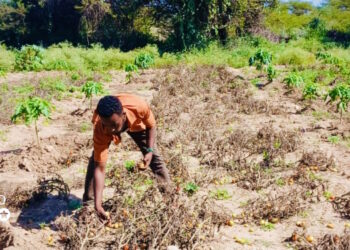
Her family’s five-hectare farm, which was planted with vegetables, maize, and beans, was destroyed in a shelling attack in Barire on 10 July.
Farhiya said they lost $400 they had invested in the farm, including a $100 loan. Two of her children have dropped out of Koranic school because she cannot afford the $6 monthly tuition fees.
Istahil Omar Abdi, a mother of five, has been living in the open field near Afgoye since 18 July. They also eat at most a single meal a day from food provided by locals. Istahil, who is six months pregnant, said she had been looking for cleaning jobs in Afgoye but had no luck, as she doesn’t know anyone and there are many people looking for similar work.
Istahil’s family fled a bombardment that destroyed their two huts and their four-hectare farm. They walked for two days and nights to reach Afgoye, with her husband carrying three of their young children on his back.
They went without food for two days on the road, and her children are now sick with what she suspects is malaria.
“We came through a very difficult journey. We went through hunger, our feet swelled up from walking, and the children couldn’t walk,” she said. “The children’s stomachs are swollen too, and now they are sick, but I have nothing to feed or treat them with.”
Istahil said her family had a balanced life in rural Barire, where they were lived off their income as farmers. This is the first time her family has been displaced, and the burden has been immense.
The chairman of a committee formed by the displaced people, Ali Osman Abdi, said they had confirmed the arrival of over 500 families in and around Afgoye in the last two months.
He said they were living in open areas because the existing IDP camps were full. Local people had provided them with limited food and sleeping mats, but it wasn’t enough to meet their essential needs.
“These people have had their entire lives destroyed,” he said. “We are asking the government and aid agencies to stand with these people and assist them with healthcare, food, water, and shelter.”
Ali said he had informed the local administration but had not received any response so far. He noted that many families of pastoralists, farmers, and villagers affected by the conflict in Lower Shabelle region were still in a precarious state without a solution to their problems.