

Unemployment in the construction sector in Galkayo, in central Somalia’s Mudug region, is causing families who were once stable to move into displacement camps as they can no longer support themselves.
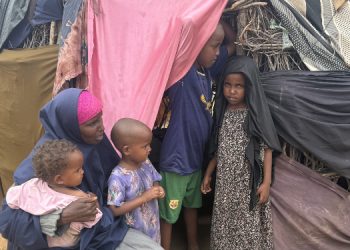
Yasin Abukar Sheikh, 26, moved his family into Alle-Aamin IDP camp on the outskirts of Galkayo last December, when he was unable to pay the $40 a month for the two-room house they were renting.
He had been earning a steady $10-$15 a day on building sites that enable him to provide three meals a day for his family. However, since becoming jobless last September, they have fallen to a new low and put together a shack made of scraps in the IDP camp.
They don’t pay any rent on the camp land, although they are at risk of eviction by the landowner at any time.
“We have forgotten when we used to get three meals a day. I go into the city, and whatever I find is cooked for the children once every 24 hours. If I don’t have anything, I talk to my wife and say I don’t have anything, and tell her to please ask something from the neighbours,” Yasin told Radio Ergo.
According to Yasin, construction companies have started hiring foreign workers, taking over jobs previously held by Somali citizens. He estimates that hundreds of Somalis have been put out of work by this growing trend.
Without any income, all they can do is rely on help from neighbours, as with debts of $150 they have been refused further credit from local shops.
His three children have dropped out of primary and Koranic school as he can’t pay the $30 monthly fees.
“We live in hardship and suffering,” he said. “Now we can’t even afford for my children to study, and we had to move to a displacement camp.”
Yasin has worked on construction sites since he was young. Every morning, he goes to nearby sites where he sees foreign workers are employed but finds no opportunities.
“It makes me feel bad when I see a job I can do being given to a foreigner. In the country where we were born, where we raised our children, and where we have endured many hardships, if a foreigner is chosen over us I see it as a big problem!”
A manager at local construction company Micraaj, Hassan Mohamed Ali, said foreign workers from Pakistan, Bangladesh, and Ethiopia were being hired due to their specialised skills in the industry.
“We currently have several Somalis working with us, but what motivates us to choose foreigners is their skills and the satisfactory work they do. One of the challenges that Somalis face is that they often leave without notice, whereas foreigners work according to the agreement,” he stated, adding that they would prefer to hire locals if they had the right skills.
Hassan pointed out that skilled foreign workers earned an average salary of $300 to $600. The company said that it was training Somali workers to improve their skills and reduce unemployment, although no further details were provided.
A former site foreman, Mohamed Hassan Omar, said he had been earning $30-$40 a day supervising building teams but now he couldn’t find permanent work. He said he could only find menial odd jobs like plastering and breaking stones, earning less than $100 a month.
“Work used to take care of a lot of our needs. Now I have to live in one room. Before, I lived in two rooms, I paid my parents’ bills, and I had enough for my children’s education and food. Now it is difficult to cover all this,” Mohamed told Radio Ergo.
Mohamed, 38, fears that financial constraints will force his family also to move to a displacement camp. He has three children who dropped out of school in November when he failed to pay the $45 monthly fees.
“Unemployment in the city is increasing. I usually get work for two days and then don’t find anything for the next 10 days.
I have become like the people I used to support when I had a salary – our family has a strong feeling of helplessness now. The foreigners have all the good jobs, and I see that as a big problem,” Mohamed said.