

(ERGO) – More than 40 shops have closed in Ruqi in Somaliland’s drought-hit Awdal region in the past two months, as widespread crop failure left local farmers unable to pay back the money they borrowed from businessmen for food and other necessities.
Businessman Jama Mohamed Hassan’s family of 17 is facing a severe food crisis now since his shop had to close. He had given out a total of $6,000 in loans to about 50 farming families in Ruqi over the past 10 months. He hasn’t been able to recover any of it.
His own family now survives on food borrowed from stores in Baki district. But they are only managing one meal a day, as the cycle of debt deepens.
“We have nothing, except God!” Jama exclaimed. “The fields are empty. Our lives are in chaos. We used to struggle to get two meals a day, but now we only get one. We are in despair.”
The financial crisis has forced four of his children to drop out of school. Their high school closed down a month ago as none of the parents in the area could afford to pay the tuition fees.
Jama, 65, noted that the drought had impoverished the whole community, whose economy is largely dependent on agriculture.
“Farmers who harvested and sold their crops used to buy from us. That’s how we co-existed and our business thrived. Now, both farmers and traders have gone bankrupt. The people who owed us money couldn’t pay back, so the shops closed,” Jama explained.
After running his shop for eight years, his income has disappeared and he is unable to refinance his store.
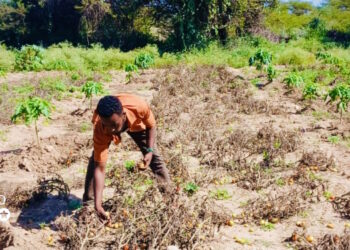
Abdinasir Abdillaahi Abdi is a farmer in Ruqi who is burdened with debts. He told Radio Ergo that he owes $3,000 for food and fuel he took from local store owners last year.
He used the fuel to run a motor pump to irrigate his farm, but the motor stopped working when the well his farm depended on dried up due to lack of rain.
“We used to manage with the harvest for about three to four months, and it would sustain us, allowing everything to function. But now, even the town where we used to get supplies — whether it was fuel assistance or goods from the shops — we have accumulated a lot of debts with all of them. As a result, we are no longer able to invest to revive our farms,” he said.
The debts and financial hardships forced him to leave his home in Ruqi. He moved to Baki district, where he found manual labour work.
Every morning, he goes to the gold mining pits located in the Simoodi mountain. Some of his fellow farmers from his area, who now work for the mining companies, accompany him.
“There are about 10 or 20 of us working there. Sometimes, you might work for five to six days without earning anything. On a lucky day, you might make 200-300 Somaliland shillings,” he said.
He sends the money he earns to support his family of nine. On days when he earns nothing, he seeks help from relatives. His family can only afford to eat once every 24 hours, and this situation has persisted since the middle of last year.
He pointed out that his biggest worry is the repayment of his debts, which has had a serious negative impact on him. He plans to return to farming if enough rainfall comes to his area.
Both the farmers and traders who have been forced to migrate share the same story of financial hardship, as the drought has directly and indirectly devastated their sources of income.
Abdisalan Mohamed Adan, who ran a grocery store, was also forced to close his business.
The financial collapse in February has caused food shortages for his family of eight.
They now share meals with a relative’s family. Before the crisis, they used to make a daily profit of $5-$7 from their shop, which was enough to meet their needs.
Like others, Abdisalan said that the economic decline had started in mid-2024.
The farmers he had extended credit to failed to pay him back after they lost two consecutive harvests.
He is owed $3,200 altogether, which would have been enough to rescue his business.
“People are different, there are individuals and there are families. Some individuals owe between $20 and $300. Many households took food supplies and accumulated large bills. Some owe as much as $1,000,” he said.
According to the local administration in Ruqi, some traders and farmers abandoned the area because they could no longer withstand the financial crisis. The town’s only high school has also closed down due to the economic decline and the departure of families.