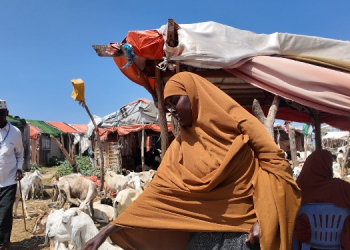


(ERGO) – Women in internal displacement camps in Abudwaq, central Somalia, are complaining that they can no longer find the domestic jobs that they had relied on because of an influx of women from neighbouring Ethiopia who work for lower pay.
Maryan Ahmed Isse’s family of eight in Sanag camp on the outskirts of Abudwaq lost her job as a cleaner last November.
“In the past three months, I haven’t worked because there are no jobs available. We’ve been replaced by foreign Ethiopian women who work for very low wages,” Maryan said.
She has turned to begging to feed her children, but often doesn’t get anything at all so her five-year-old youngest child has to try to sleep hungry.
“I’m in a bad situation. Tonight, as I speak to you, a neighbour gave me a bowl of rice and sugar, which I cooked for the children. I’m raising seven children with no father alone, older ones and young one we often sleep hungry,” Maryan explained.
She worked as a cleaner in local households for four years and says she has no other means of support. Every day, she fetches water from a borehole five kilometres away, carrying it on her back. Often, she can’t afford the $0.20 charge per 20 litres.
“This hard labour of carrying heavy loads on my back has become unbearable. Adding the long distance makes it even more difficult. Sometimes, I don’t have money to pay the fee,” she complained.
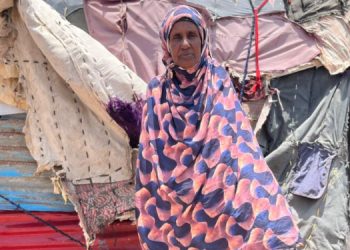
Her family lives in a hut made of sacks and poles, offering no protection against the cold nights or scorching days. She doesn’t have money to make a better shelter. Additionally, the overall economy is hard these days due to the current drought.
“When drought hit and resources became scarce, people stopped giving credit or loans, even to close relatives. Everyone is struggling equally in this area,” Maryan told Radio Ergo.
Two of her children attending Hirdo Primary School, three kilometres from the camp, were sent home at the end of January due to $60 unpaid fees over four months. Her eighth-grade son’s education is now uncertain, and she fears his prospects will suffer.
Maryan’s family originally came from Galgadud region, where they were livestock herders. Drought killed 100 of their goats in 2020, forcing them into displacement. Her loss of employment opportunities has pushed them into an even worse situation.
Displaced families living in 36 IDP camps around Abudwaq face similar challenges of few job opportunities, increasing competition, and a local population with little money to spend. Many women that Radio Ergo spoke with complained of losing jobs to foreigners.
Baar Hassan Abdulle, supporting a family of 11, told Radio Ergo that she cannot afford regular meals. Previously her earnings of $4-6 daily from cleaning jobs enabled her to provide for their basic needs. Now uncertainty looms over her household.
“In the past, we ate three times a day. Now we’re lucky if we eat once. Sometimes we go to bed hungry. Food comes either from close relatives or strangers we ask for help,” Baar said.
She repeatedly approached her former employers for work but found herself replaced by Ethiopian women willing to work for $50 a month, instead of the $2 daily wage she was earning.
Unemployment has affected every aspect of Baar’s life. Her makeshift house, constructed from mosquito nets, sticks, and cardboard, offers little shelter. Wind and sun have damaged it further, yet she lacks the means to repair it.
“Four children who attended primary school have stopped going due to unpaid fees of $100 for three months. Education is now out of reach,” Baar lamented.
When she first arrived in Somaliweyn IDP camp eight years ago, fleeing drought in Dollow in Gedo region, she had already lost all her goats and 20 camels. Taking on domestic work had enabled her to keep the family going.
Murayad Salad Guled, a mother of 12, relied on washing and drying clothes for nearly a decade to support her family. However, she says the influx of foreign women working cheaply has left her struggling to secure even occasional work.
“In the past five months, I’ve only worked nine days. Every morning, I search for cleaning jobs but return empty-handed and exhausted by afternoon. Going out to find work has proven futile,” Murayad said.
She expressed frustration about losing the opportunities that had been available. Without connections in the city, she finds no one to assist her now that she is unemployed.
“We live in a camp facing numerous problems and neglect. Before, we washed clothes to provide for our children. Now, Oromo women have taken over those jobs. Sometimes, neighbours help us with food, but other nights, we sleep hungry,” Murayad said.
Her family was displaced in 2017 from Baal-goray in Galgadud region after losing 400 goats and 16 camels to drought and disease. Initially they found life in the camp offered some relief after their rural hardships.