

(ERGO) – One hundeed Somali farmers whose fields were destroyed by floods are benefiting from a farming project that has employed them to cultivate 5,000 hectares in Yoontoy, 25 kilometres from Kismayo, where the United Arab Emirates government is growing bananas.
Salat Abbas Adan leads a team of 25 men, who plant 552 banana trees a day. Each worker earns $260 per month, which helps Salat provide regular food for his family of 10.
“In August 2024, two of my sons and two daughters stopped attending school due to financial difficulties. In January this year, I was able to re-enroll them thanks to this job,” Salat explained.
He detailed how he manages his earnings: “$100 goes toward food for the children. Sixty dollars covers their schooling and clothes. Fifty dollars is used for personal expenses, and another fifty for vegetable purchases. My family lives together, and we rely on God for anything extra. Life is stable now I’m a regular salary earner.”
Salat spends five hours a day planting bananas. He sees this as a rare opportunity in an area where jobs are scarce and financial prospects limited.
“I was fortunate to be selected for this work based on my poor circumstances and my farming skills. Since 2023, when floods destroyed my 4-hectare farm, I’ve struggled to recover financially. It was our only source of income, but I couldn’t afford to restore the farm,” Salat said.
He owes $200 in debts from 2023 and is dedicating $50 a monthly to repay the amount.
“I focus on saving part of my salary every few months to reinvest in my farm. Additionally, I’m learning modern agricultural techniques through training provided by both Somalis and foreigners working on the project. This knowledge will benefit me as a farmer,” Salat added.
“The process of planting bananas differs from traditional methods. Measurements and precise calculations guide us, similar to constructing a house. After measuring, we dig holes, insert the plants, remove the bags, add fertilizer, bury the roots, and irrigate them.”
This land, once used by the Somali government for rice cultivation, is now leased to the UAE government. The bananas grown here will be exported to the UAE and other global markets under a 60-year agreement signed in early 2023 between the Jubbaland administration and the UAE.
Another local farmer, Adan Abdinur Dini, who joined the project in January, said he enjoys the stability this job provides. He supports a family of nine and has improved their living conditions significantly.
“For the past two years, without farming or cultivation, life was extremely difficult. We could barely afford three meals a day. Now, my family eats regularly, and I see this as a divine blessing,” Adan stated.
Before joining the project, Adan worked odd jobs since 2023 – sometimes farming, sometimes quarrying – but earning less than $2 daily.
“I spend the money on my seven to eight children. Feeding them, paying for school, and buying essentials were challenges before. Now, with this opportunity, I plan to save money to revive my farm. Working for someone else isn’t ideal; I prefer self-reliance,” Adan said.
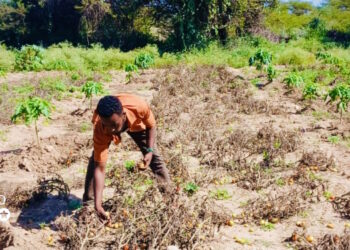
In May last year, a flood destroyed his 6-hectare farm and home in Yoontoy. While he managed to rebuild his three-room house, reviving the farm proved impossible until now.
The deputy district commissioner of Yoontoy, Yusuf Abdi Mohamed, told Radio Ergo that those benefiting from the project were among the poorest families affected by the floods.
“Only men were chosen for the first phase because planting bananas requires physical labour like digging holes. Women farmers affected by the floods will be included in future phases,” Yusuf explained.
“This job creation is the largest opportunity the people in this area have received. We identified individuals struggling to make ends meet and offered them employment. Today, they live better lives than many others. These workers were once in desperate situations.”
The second phase of the project aims to employ additional farmers impacted by climate change, offering a long-term solution to their hardships.