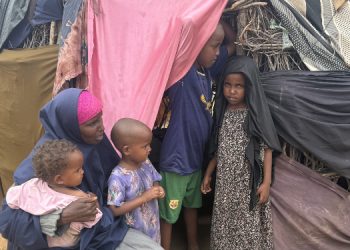


Sahra Mohamed Ahmed, a refugee in Dadaab, has been struggling to get food for her 14 children since food aid was cut in the camps in northern Kenya.
As well as needing the food rations herself, she is among dozens of women who were earning 100-150 Kenyan shillings ($0.8-1.1) for portering food for other refugee families from the World Food Programme’s aid distribution centre to their houses.
“The situation is difficult for my family. I work hard for them. Their father is an elderly man, and we have nothing. I was portering carrying loads of 12, 13 or 14 kgs. Now, each person is carrying their own stuff, and I can’t find work. When I ask people if they want my services carrying something they say no, they will do it themselves,” she said.
According to Sahra, the $80 to $120 per month she made from portering has supported her family over the past 15 years.
Now they rely on her 17-year-old son, who delivers water in the camp charging 5 Kenyan shillings per jerrycan. They buy whatever food they can in the market with the money he makes.
“When my children are hungry, I feel the need to do everything I can to feed them,” Sahra said, explaining that the has been taking laundry jobs that make her only $2-$3 every two or three days.
“The doctor told me to stop carrying heavy loads because I’m pregnant, but I told him I have no choice; I need to feed my children. I suffer from asthma and am on medication to keep going and take care of my children’s needs,” she said.
Sahra and her family came to Hagadera camp in Dadaab in 2008 after repeated river floods destroyed harvests on their farm in Bender-Jadiid in Jamame, Lower Juba region.
Another refugee Khadijo Hasan Adan hasn’t found a portering job since July. She has been in Dadaab since her family fled their 4-hectare farm in Jamame district in 2019 due to conflict.
“We are poor people, living hand-to-mouth with nothing to sustain us. We don’t have any means of survival, and when the food runs out, we have no other options. Some nights, we have only plain rice with nothing because we can’t afford it,” she complained.
Khadijo said she made $85 to $100 a month portering and their own food rations of 22 kilos each of rice and sorghum barely last her family of 10 children for two weeks.
“When I see my hungry children, it’s sad because I have nowhere to work and no way to provide for them. When my husband and I both return home empty-handed, and there’s nothing to cook, we have no choice but to sleep hungry,” she said.
Her husband hasn’t found any construction work for the past five months. Khadijo has made $62 from cleaning jobs in the past two months. Five of her children had to drop out of school as she couldn’t raise the $24 for their fees.
Suldano Ibrahim Abdulle, another former porter, said that local businesses have stopped offering them credit facilities.
“I’ve been unable to cook for my children because the store has refused to give us credit anymore. My food ration card only covers four people, and that’s not enough. We no longer eat meat or vegetables and the sorghum can’t last us for a month. The store owners won’t give us credit because they know we can’t repay it. We are in a difficult situation and we only pray to God for help,” she said.
Suldano says she has a bad back from her work carrying heavy loads that stops her sleeping but she can’t afford to go to a doctor. Her family now survives on small donations from other local people and the mosque.
Suldano’s family fled Mogadishu in 2011 due to insecurity. She had a small clothing stall there. After 13 years in the refugee camps, she has no hope of returning home as she has no resources or support to help her move back.