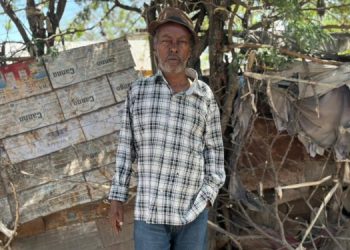


(ERGO) – Since being trained and equipped for productive beekeeping, former farmer Omar Mohamud Bare has been making a good living for his wife and nine children in Somalia’s north-eastern town of Qardo in Puntland state.
Omar has been keeping bees in six boxes and is able to harvest 20-25 kilograms of honey that makes him up to $600 profit a month.
“My productivity has improved. I used to harvest honey just once in six months, though now I get to harvest it every month because of the equipment we got. We sell a kilo for $25 or $30 at most. I use the income to support my family and pay for the children’s education,” he said.
Omar and his family were displaced after their two-hectare farm in the rural area failed in the severe drought. The new skills have put him back on his feet since he began in January.
“We have learned how to keep bees and make money from it. We have also got the equipment including the boxes. I couldn’t move them from the farm, but now I can take them wherever there are flowers or vegetation. We have also got the equipment to harvest the honey,” he said.
He is taking care of his family’s needs and investing in new equipment and hiring employees to expand his business.
A hundred local people received beekeeping training and equipment from the UN’s Food and Agriculture Organisation (FAO) and Puntland administration to start new livelihoods to replace the farms and livestock they had lost to the drought.
Among them is Abdullahi Hersi Mohamed, with five bee boxes that have been earning him for $500-550 a month.
“I am happy every time I harvest, it has really contributed to the education, bills, loans and other things. My family work with me on the bees, my children and wife are motivated and they all work with me,” said Abdullahi, a father of six.
Abdullahi moved his family to Qardo from Aduro, where they had been living since 2017 along with many other drought displaced families from other regions. He lost his herd of 200 goats to drought.
He now lives in the town with his family and keeps his bees in his relative’s yard where he has planted flowers for his bees. He sells his honey to Qardo residents and since being trained the quality of his honey is good.
“I feel that the honey is pure, there is no debris or soil particles in it. There are no broken tree parts, most of my customers use it for health purposes,” he said.
Four of his children are in a local school where he pays $30 a month for their fees. He also plans to take two younger ones to Koranic school.
Before bee keeping, Abdullahi had been selling fish in the Qardo streets making just $3-4 a day that covered meals and some of their costs. Now he is saving $150 a month with the hope of increasing his bees and honey output.
The beekeepers have formed a cooperative to address their issues and work on improving their business. The cooperative head, Abdiwasi Bilal Abdow, told Radio Ergo the training has motivated them and enabled them to improve their income. They are focusing on honey marketing to further improve their sales.
They receive orders from different regions as well as from the Somali diaspora. The cooperative has stabilised prices and been seeking new markets for the members.
They have also been dealing with issues relating to their business. He noted that the bee population has been dropping in the past few years as there have been people who have been infringing their habitats in the valley areas.
One of the main threats to the business, however, comes from people destroying the environmental habitat of the bees.
“There are two ways people destroy the bees – they destroy their hives and cut down the trees,” Abdiwasi said.
“We inform the authorities when people invade our bees and destroy them despite us fencing these areas and placing guards. Some of the areas have been attacked and the bees destroyed. We want the authorities to address these issues.”
Bee keeping has been increasing as a livelihood in recent years, whereas before people generally saw it as unsafe and hard to make good income.