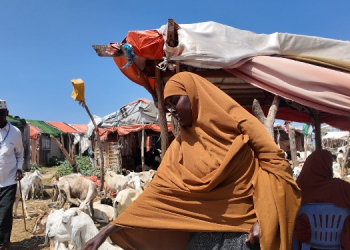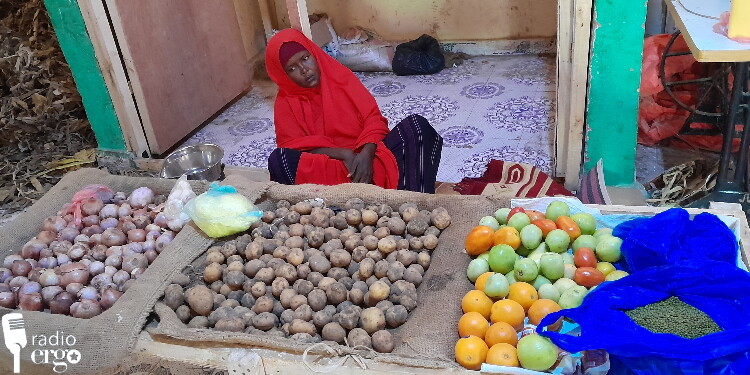
(ERGO) – Women traders relocated from a busy roadside to a new off-road market in Istanbul area, 20 kilometres north of Kismayo, are struggling to support their families after losing access to passing trade that was their mainstay.
The 60 or so displaced women were moved from the tarmac roadside to a newly built market further inside the settlement. Although the relocation was intended to improve safety, many women say it had the adverse effect of diminishing their income.
Adey Nasib Abdi, a mother of seven, now spends her nights trying to sell vegetables from her small table but often returns home without earning enough to feed her children. Since the relocation at the end of March, she says her income has dropped sharply.
“The market is crowded with people like us bringing vegetables. Customers are used to buying from the roadside. Where we are inside the market, even cars cannot reach it. A customer with money will not come all the way in to find you. People buy outside and leave,” she told Radio Ergo.
Adey says that in the past three weeks, 500 bananas and three jerrycans of tomatoes went bad because she hadn’t had enough customers at her stall. She owes $75 to farmers who supplied her with fresh produce.
The $7 to $10 a day that she earned by the roadside was enough to support her household. Sometimes in the new market she makes as little as half a dollar.
“The vegetables have gone bad. We are in a lot of debt. Someone may bring 500 bananas and sell only 10, and the rest are left to rot. Fresh vegetables can’t last beyond a day. We have suffered heavy losses,” she complained.
“I take food on credit for the children now. People in town know me as the woman who sells vegetables. I try to call those who owe me money to pay me. I try to manage for two days, but I am no longer anywhere near how I used to be.”
Adey started her business 18 months ago with $20 she earned from construction work and built it into a reliable source of income before the move disrupted her progress. But she acknowledges that working at the roadside had its dangers.
“We were in danger there. We sold right next to the road where vehicles pass. It was extremely hot. We used to get very hot and so did the water we carried with us. My skin even changed. It was a dangerous place. You could not keep children there. We suffered a lot,” she said.
However, she believes the new market will only work if customers are brought closer or if more traders are relocated together to attract business.
Like many others in the settlement, Adey was displaced in 2022 from rural Afmadow after drought wiped out 250 goats her family depended on.
Farhia Abdullahi Mohamed, another trader in the same area, also says she is facing losses as her customers were those passing by along the road.
“We are facing a lack of customers. No one is buying from us. What we bring gets spoiled. This morning I argued with farmers as I have nothing to pay them. I have suffered major losses. The watermelons are spoiled, bananas are spoiled, lemons spoiled, peppers spoiled,” she said in frustration.
She owes $46 in debt for produce she took on credit. Creditors recently threatened legal action when she failed to repay the debt, only backing off after neighbours intervened.
Farhia, a single mother of eight, was displaced by floods in late 2023 that destroyed her seven-hectare farm near Jamame. She has withdrawn five of her children from school because she can no longer afford the $15 monthly fees.
The market where the women now operate was built by Jubbaland’s Ministry of Public Works and Housing, with support from the local organisation SEA and funding from GIZ.
Local authorities say the relocation was necessary due to safety concerns, as traders had been operating along a busy road where speeding vehicles posed risks.
The chairman of Istanbul, Jama Kayd Halane, said the new market includes 48 tables, 12 stalls, and designated areas for food vendors.
“This is a new place and people have only recently moved in. It takes time for a place to become known. People have left a place they were used to and come to a new one, so there can be delays. Before, they were in the sun along the roadside. Now they are in a shaded and more suitable environment,” he said.
He added that the number of traders exceeded the current capacity in the new market and called for expansion with support from authorities and donors.