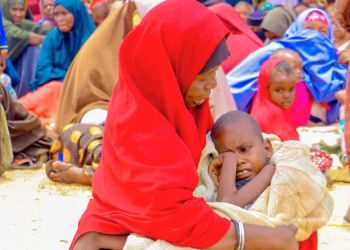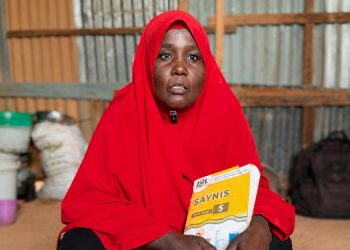


Khadija Jama Yusuf, 70, lives a lonely life in Hagadera camp in northern Kenya’s Dadaab refugee complex, without any children or other close family to support her despite her age and disability.
Life was particularly hard for her in July, when her wheelchair broke. She got a replacement at the end of August thanks to a group of youth in the camp, who helped her raise 15,000 shillings to buy it.
She struggles to support herself on the cash aid that has been halved recently and the reduced rations allocated to refugees.
“I used to look forward to the cash aid but now it’s down to just 450 shillings [about $3]. Can a human being survive on that? I don’t have any other source of income,” Khadija complained.
A neighbour, who decided to help her because she saw how alone and abandoned the elderly woman was, gives her cooked food twice a day.
“I live in a good neighbourhood. I call my neighbour by phone and she rushes to come to me and brings me food. She is the only person who gives me anything. I don’t get anything else from anyone. She brings me three flatbreads in the morning and at night she gets me beans and rice. She is also poor,” Khadija told Radio Ergo’s local reporter.
Khadija lost the use of her legs in 1993 when a stray bullet hit her as she was walking to Afgoye from Mogadishu, carrying her young son on her back. Tragically her son was killed and she was left paralysed in her lower body. She had already separated from her husband and although she married again, she had no more children and was divorced again by her second husband.
She came to Dadaab in 2006 from Garowe, Nugal, hoping to get a better life in the refugee camp. But the hut made of sticks that she lives in in the camp is flimsy and the poor shelter adds to her misery and sense of abandonment.
“I live in this small hut; I don’t even have a mattress. I face many challenges. I am particularly bothered about loneliness…I am getting old. I don’t have a son or parents, I don’t even have grandparents,” she said.
Khadija suffers from high blood pressure and diabetes and says she needs regular medication that she cannot afford.
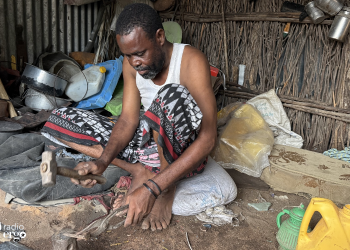
Similarly lonely and neglected in Hagadera camp is Abdi Abdow Ahmed, 73, a veteran Somali army soldier.
With no close relatives living with him, he struggles to move around N5 neighbourhood in the camp using crutches due to war wounds that left him disabled.
He says the monthly aid of three kilograms of wheat and sorghum, five litres of cooking oil, and 450 Kenyan shillings is woefully inadequate.
“It’s not enough! It’s not enough! What is three kilograms, how? It is food for three days. It’s not enough. I am hungry every day,” said Abdi.
His wife and five children were all killed when their house in Mogadishu was hit by shelling in 1997 during the civil war, whilst he was away serving in the military in Hargeisa.
Although he has a small shack, he prefers to sleep in the shade in the compound of the Save the Children school in the camp, where he can access water from the tap.
“The challenge I face is poor housing, I don’t have clothing, I don’t have bedding, I don’t even have a mat to sleep on,” he said.
Abdi told Radio Ergo’s local reporter that his health has been deteriorating. He has diabetes and high blood pressure but cannot afford medication, forcing him to beg from the health centres.
“I get painkillers from the health boss and when I don’t find them I get referred to the hospital. I only get painkillers from them, there is nothing else I get. When I get to the pharmacy I tell them about my situation and ask them for medicines. It’s all begging, that is how I live,” he said.
Having been a refugee for more than two decades in Hagadera, Abdi describes loneliness as the worst scourge.
The head of the elderly people’s association in Hagadera, Adan Qorah Boorle, said the plight of the elderly in the camp was concerning. He said that five elderly men aged between 70 and 80 died of neglect last year.
Adan said there were around 2,400 elderly men and women aged 70 and over living in Hagadera camp, most of whom suffered from poor shelter and food shortage.