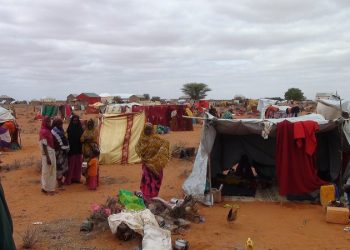


(ERGO) – Around 500 families fleeing drought and insecurity in different parts of Bakool region have migrated to government controlled Dhurey village in Rabdhure district, where they are facing food shortage and lack of proper shelter in a camp.
Guray Adan was one of the first people to migrate to Dhurey, hoping to get a better life for her family. She and her 10 children left Dhanawe village in Rabdhure district on 8 May and walked for four hours the 32 kilometres to reach Dhurey.
A pastoralist, she lost her 200 goats and 100 cows to drought spanning over four years in the Al-Shabab controlled area where they lived.
She is now destitute despite her previous proud lifestyle and feels they have been reduced to beggars who are depending on local people for food.
“We live on what we get from the people of Dhurey. We need help, we need it from the aid agencies,” she said.
Although she now feels safe, she has been struggling to get food for her children. They are living rough under makeshift shelters that barely give them any protection.
“Our family doesn’t have bedding or utensils. We don’t even have drinking cups. We don’t have anything,” she said.
Most of the IDPs now in Dhurey are women and children from other villages in Rabdhure and Wajid districts of Bakool, who arrived in the hope of finding aid in the camp.
Nuriye Ismail Hassan, 45, fled from Burdhunle village in Bakool also on 8 May, after the last goat in her original herd of 250 perished in the drought.
She said they left the village without carrying anything and have since been struggling to get a good night sleep camped under the trees.
“We sleep under the trees. We don’t have bedding; we sleep on pieces of clothing. We don’t have a life! Now that we have been displaced here, we can’t get anything to eat except what the neighbours give us,” she complained.
As a widow, she has been struggling to raise her nine children alone.
Despite the hardships, though, they are glad to find peace in the camp, where there is also running water from wells that provide water even in the dry seasons.
“Our camels died and so did the goats. Drought hit us, and there was no vegetation growing. The children were drinking dirty water and eating whatever garbage they could find, those were really unfortunate times,” she said, speaking of life back in their village.
The commissioner of Dhurey village, Hassan Abdi, told Radio Ergo that the number of displaced families joining the camps has been increasing daily, but with their limited capacity they have only been able to help these families settle in the camp.
He appealed to the aid organisations operating in South West state to provide urgent assistance to the displaced families.
“The biggest problems in this area are food shortage and poor shelters. There is no shelter for them, they are people who left their homes and their utensils and belongings when they migrated. They were displaced by the dire situation where they came from,” he said.
Hassan noted that since the beginning of this year, pastoralists and famers have been fleeing their villages and joining the camp in Dhurey. Most are people whose livestock died in the long drought while others lost their farm produce due to successive failed rainy seasons.