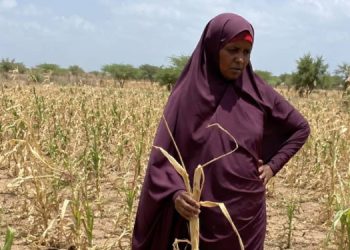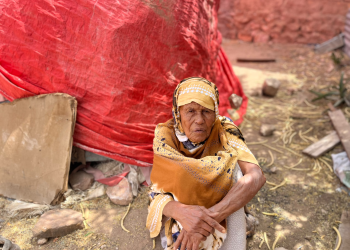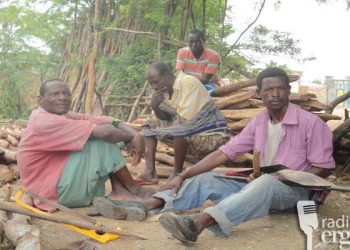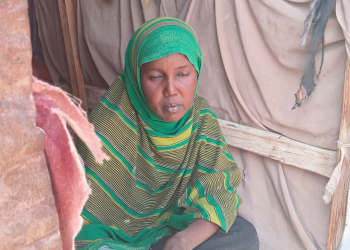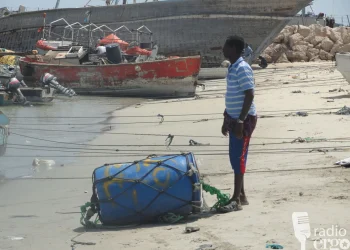


(ERGO) – Abdinoor Salad Omar, a pastoralist in Dajimale in central Somalia’s Mudug region, has lost 200 goats since October 2022 and believes that his last remaining 20 goats may die this month.
The animals are so thin that they produce no milk and cannot be sold for meat to bring in any cash.
This village, 110 kilometres south of Galkayo, has not received any rainfall for the past three rainy seasons.
After the water well dried up, Abdinoor has been losing his livestock one by one, watching them as they weaken pitifully without any fodder and hardly any water to drink.
“The well has not had any water for some time and that is why our livestock are dying. The well is totally dry now and there is no other water near here. The water catchments are also dry,” Abdinoor told Radio Ergo.
The 600 families living in Dajimale village are all facing similar hardships that looks set to leave them deprived of a livelihood.
Water for people and animals is trucked in by businessmen from Hingo, Hule and Awrla, located 50 kilometres or more away, and sold at $7 or $8 a barrel due to the high costs of transport.
Abdinoor, who has not been able to make any money from his livestock, cannot afford the water prices.
In September 2022, when ran out of money, he stopped buying them feed.
Then he sold his three camels in September and October for $200-300 a head and used the money to buy food and trucked-in water for his family of seven.
Cycle of Debt Mounts for Pastoralists
His debts continued to mount with relatives running a shop in Galkayo. Over the last two years of drought, he has accumulated $2,500 in debt. The shopkeepers told him they will not give him any more food on credit now until he pays off some of the debt.
“I couldn’t pay off the debts and I couldn’t sell any of the goats. I was looking for buyers but I couldn’t find any and the goats kept dying,” he said.
“If you borrow $5,000 you should at least be able to repay $3,000. But whatever livestock we sold, the money went on buying water from the transporters even though the goats just died.”
This father is raising his seven children alone after his wife died a year ago. The additional family role has added more pressure and he cannot find any odd jobs to boost their income.
They now get just one meal a day. He waters his goats once a week, although he is giving up on his livestock to focus more on water and food for the children.
“I depended on my goats. When we had water we used to milk them, and we would even sell them for their meat, but now all that has disappeared.
I was a man who took take care of his goats. Everyone is in a similar situation now,” he mourned.
Another villager, Hassan Elmi Gulafe, and his family of nine also lost most of their livestock due to the drought and water shortage.
“Three of my five donkeys died of thirst. Both my camels died as well. I also had 200 goats, and 160 of them died, only 40 have remained,” Hassan said.
“They all perished at once and now we are facing continuing drought and water scarcity.”
Villagers on the verge of famine
Hassan tried to migrate with his livestock to search for water but they were too weak to walk.
His relatives donated 26 kgs of flour, rice and sugar, but the food is quickly getting depleted. Beyond that, he does not know what he will do.
The deputy commissioner of Damijale, Nur Abdi Arab, told Radio Ergo the families in the village and nearby areas are all on the verge of famine. The loss of the swater well truck a heavy blow.
The village authority has tried to collect funds for the most vulnerable families but has no capacity to deliver aid to them. They have reached out to the Galmudug government but have not had a response.
“We have tried to do something although our capacity is limited. We have raised the alarm so that we can help these people facing hardships. They are our own people, but the biggest thing we can do is to share their message,” said Nur.
With no schools and health centres, sick people and pregnant women have to go to Galkayo for treatment. Many cannot afford the transport.