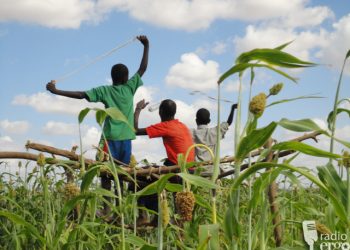


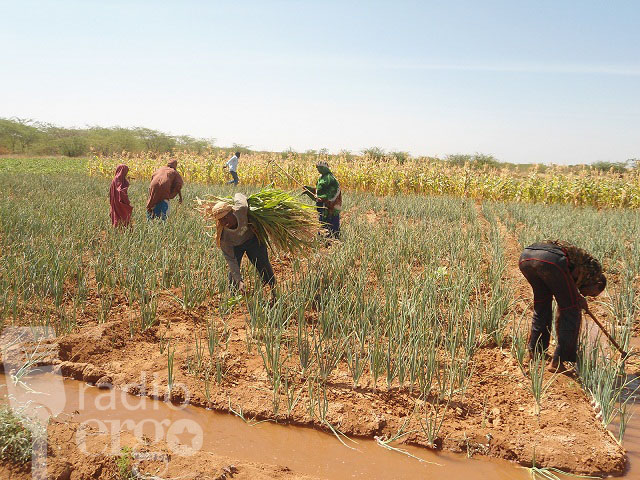
(ERGO) – Ali Ahmed Ali, who owns a three-hectare farm on the outskirts of the southern Somali town of Baidoa, harvested beans, sorghum and maize in mid-January, despite the threat of locusts that have devastated many farms in this part of the country.
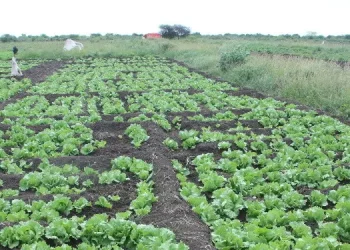
He is among 95 farmers whose crops survived the locust invasion in the villages of Bonkay, Goyale, Salbuuy and Koron-rooge in Bay region, after the community joined hands to do all they could to protect their investments and livelihoods by warding off the insect swarms.
Ali invested $370 in his farm, which is in Bonkay village, on the outskirts of Baidoa. Some of his family members took part in guarding the farm, while other farmers in the village received help from soldiers who fired in the air to help try to repel the locusts, which invaded three times.
“God protected our crops from the locusts! On our end we used smoke while the soldiers used their guns against the insects. We also used cans filled with stones, shaking them to frighten off the locusts,” Ali said.
Fearing that the locusts might damage his crops, Ali actually planted far less than normal to minimise the risk of losses. Most of his harvest, the largest part being sorghum, will be eaten by his family as there is a shortage of food in the area due to the sharp decline in agricultural production. Of the hundreds of farmers in Bonkay, less than 20 families planted last September, raising fears of a pending food shortage in Bay region.
“I harvested 20 bags of sorghum because of the locust invasion, although I used to harvest 30-40 bags of sorghum. My other crops, beans and groundnuts, were eaten by the locusts,” Ali told Ergo.
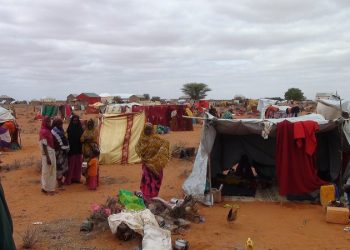
“We have seen some South West farmers who lost everything to the locusts and were forced to flee the region, but for us this is what we harvested.”
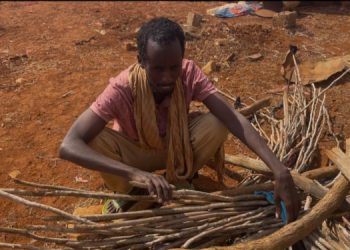
In 2020, Ali lost more than $500 that he had invested after the locusts first invaded. These early losses prompted some farmers to rally together to try to control the pests locally.They guarded their farms around the clock, working together closely and sharing information with other villages as well about locust sightings and movements.
Another local farmer, Dahabo Warsame Mohamed, a mother of seven, harvested only 13 bags of sorghum. She said this season had been very tough and she had spent most of her time defending her small plantation from the locusts.
The Bay Regional Farmers’ Cooperative said there had been a sharp decline in agricultural production in Bay, due to the locusts and the poor rainfall. Abdinur Ibrahim Mohamed, the chairman, told Radio Ergo that out of 12,472 farms in Bay region, less than 100 farms on the outskirts of Baidoa had harvested. This is causing a food shortage that is already been felt in food and vegetable markets. He estimates that the overall harvest has dropped by 80 percent.
“Some farmers didn’t plant for fear of locusts while the few who planted crops such as maize, beans, sorghum and sesame, have lost some of their crops to the locusts and the poor rainfall the region experienced, so the market is not good,” Ibrahim said.
The last three rainy seasons have been very poor, with the worst losses occurring in recent years. This has discouraged many farmers from cultivating. What little was harvested will be consumed at home by the successful farming families instead of sold in the market.